Inspiration · packaging · 30 entries
Best Thai Packaging Design

Information verified as of April 2026
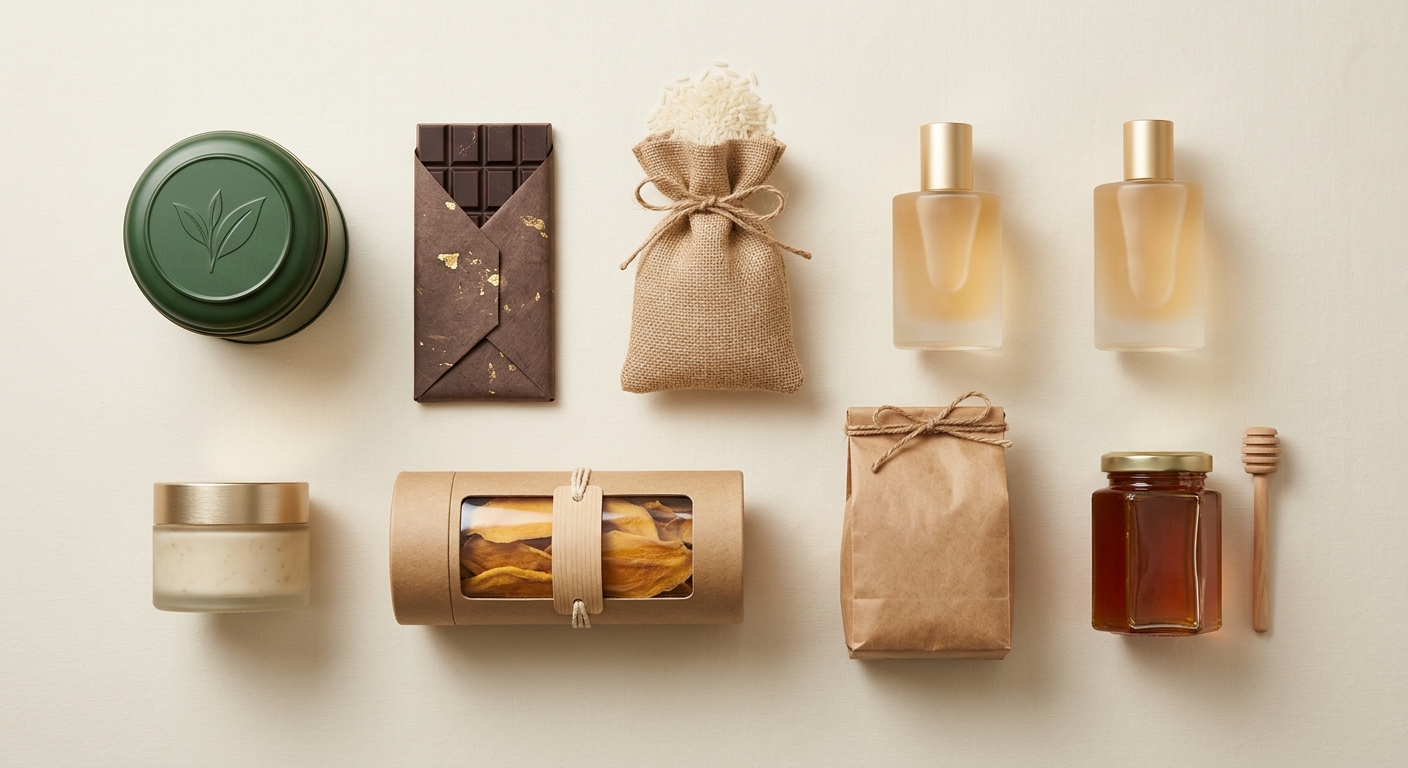
What makes Thai packaging design distinctive
Thai packaging at its best combines three sensibilities rarely held in the same work elsewhere: a craft-literate relationship to traditional motif and material, a playful and often surprising sense of colour, and an export-ready discipline around legibility and structure. The country has become the ASEAN leader in international packaging-design recognition — Thai studios won 58 Red Dot Packaging Design Awards between 2015 and 2025, more than any other Southeast Asian country (Red Dot, 2025). The commercial pull is strong: Thailand’s FMCG export sector reached USD 32.4 billion in 2024 and packaging is one of the largest investment areas across the sector (DITP, 2024).
This gallery is organised by packaging category — street food, craft and artisan, premium export FMCG, beverage, cosmetics and wellness, and snacks and confectionery. Each section describes the visual conventions at work, what distinguishes strong examples from weak ones, and what to study if you are trying to design in the category.
Street-food packaging
Thai street-food packaging is the country’s most distinctive vernacular design tradition — a language of hand-lettered price tags, red-and-white gingham paper, bamboo steamer labels, and pink plastic bags that has influenced two generations of contemporary Thai graphic designers. The strongest contemporary work in this category does not mimic the vernacular directly but synthesises it: the gingham reappears as a restrained visual nod rather than a full pattern, the hand-lettering is redrawn with proportional discipline, and the colour warmth is preserved while the rest of the system moves toward international legibility.
What to notice in strong street-food packaging work:
- A single vernacular element (paper stock, hand-lettered mark, stamp, tape) treated as a brand asset rather than a decoration
- Warm, food-forward colour palettes grounded in actual Thai street-food colours (chilli red, pandan green, mango yellow, coconut cream)
- Photography that holds a level of imperfection — steam, scorch marks, spill — rather than studio-polished product shots
- Thai and Latin text set at parallel weights so the Thai does not read as supplementary
Craft and artisan packaging
Craft and artisan packaging in Thailand covers herbal products, handmade food and beverage, small-batch cosmetics, and heritage-craft products — categories where authenticity signal is the primary brand lever. The visual strategy in this category tends to lean on traditional Thai typography (often with loops, reflecting the heritage signal), paper and board stocks with visible texture, and illustration that draws from Thai folk-art traditions rather than international craft-label conventions.
Conventions to study:
- Restrained pattern use — traditional Thai patterns used structurally (border, frame, back-panel) rather than as overall surface pattern
- Paper stock selection as a primary design decision, with uncoated, kraft, or handmade papers common
- Illustration styles grounded in Thai folk traditions (mural painting, Thai shadow-puppet forms, temple illustration) rather than international craft conventions
- Sparse use of gold and metallic inks as heritage signals — powerful when restrained, easily tipped into over-decoration when not
Premium export FMCG
Premium export FMCG is the category that produces most of Thailand’s international packaging awards — beverages, sauces, coconut products, and premium snacks designed to compete in Tokyo, London, Dubai, and New York retail environments. The design discipline here is strict: international legibility, a strong nutritional and ingredient hierarchy, compliance with import regulations across multiple markets, and a visual identity distinctive enough to stand out on foreign shelves where Thai context cannot be assumed.
What distinguishes strong export work:
- Brand identity that holds without Thai-specific context — the work reads as a confident global brand that happens to be Thai, not as a Thai product
- Photography or illustration showing provenance clearly (specific region, specific maker, specific process) rather than generic Thai-country signals
- Typography set to international conventions with Thai typography either omitted or used as a language variant rather than as exoticism
- Restrained or strategic use of Thai-specific visual signals — a mark, a colour, a pattern detail — rather than full Thai-themed treatments
Beverage packaging
Thai beverage packaging covers a broad range — craft beer, small-batch spirits, tea and coffee, coconut water, fruit juice, and the growing functional-beverage category — and is one of the most internationally awarded Thai packaging sub-categories, with strong representation at Red Dot, Dieline, and Packaging of the World. The category reward structure strongly favours bold identity, clear hierarchy, and product-first visual storytelling.
Visual conventions across strong Thai beverage work:
- Bottle and can shape treated as part of the brand design, not as a neutral container to decorate
- Colour-led identity systems with strong singular accent colours rather than multi-colour palettes
- Type-forward labels where the brand mark does most of the identity work
- Material experimentation — paper labels on glass, foil blocking, uncoated substrates, visible texture
- Restrained use of Thai motif, usually as a single distinctive detail rather than a themed treatment
Cosmetics and wellness packaging
Cosmetics and wellness is one of the fastest-growing Thai packaging categories, driven by the Thai beauty industry’s strong regional presence and the country’s wellness-tourism positioning; the category produces work ranging from traditional-spa-heritage to minimalist-contemporary. The design challenge in this category is holding Thai cultural authenticity (which many Thai wellness brands use as a differentiator in the global market) while meeting international cosmetics packaging standards and retail conventions.
Approaches that work in this category:
- Heritage-referenced systems using traditional Thai materials (teak, rattan, silk) as design motifs in a restrained contemporary treatment
- Botanical illustration drawing from actual Thai medicinal and cosmetic plants (lemongrass, galangal, pandan, butterfly pea)
- Minimalist systems that lean into the global clean-beauty convention while keeping a Thai accent in the brand mark or typography
- Colour palettes grounded in Thaitone traditional colour relationships — particularly the earthy greens and warm neutrals of Thai herbal traditions
Snacks and confectionery
Thai snack and confectionery packaging is the country’s most playful and colour-confident category, reflecting both the vernacular energy of Thai street markets and the competitive visual demands of modern convenience retail. The category produces some of the strongest Thai design work at the intersection of illustration, character, and typography.
Conventions to study:
- Illustration-driven systems with strong character and proprietary visual language
- Confident colour combinations that Western conventions would avoid — hot pink with lime green, magenta with mustard, electric blue with coral — deployed with discipline rather than randomness
- Playful typography, often custom-drawn or heavily modified, as primary identity carrier
- Pattern systems that multiply across the product line while preserving individual SKU distinction
Regulatory and material context
Thai packaging design operates within a regulatory framework that affects design choice more than most international designers realise: FDA Thailand requires specific nutritional-label formats, halal certification appears on a large share of Thai packaging for export into Islamic markets, and the Thai Industrial Standards Institute (TISI) mark appears on category-specific packaging. The practical implication is that Thai packaging designers develop early habits around information hierarchy, label zones, and multi-market compliance that often exceed the equivalent discipline in Western design schools.
Material context matters too. Thailand is a major paper and board producer (SCG Packaging is one of the largest in Southeast Asia), which gives Thai designers access to a wider range of paper stocks at lower cost than designers in many regional markets. The range of available flexible-packaging substrates is similarly broad. This availability is part of why Thai packaging design has become internationally competitive — the production infrastructure supports design ambition.
How this gallery is curated
ThaiGraph’s packaging gallery is curated by the editorial team from public submissions, published award archives, studio portfolios, and direct studio outreach; inclusion is based on craft, originality, and contribution to the Thai packaging design tradition rather than commercial scale. The gallery aims to represent the range of Thai packaging practice rather than to rank specific work.
Submission criteria:
- Work must be original and the submitter must hold or have permission to share the rights
- Work must be produced in Thailand or by a Thai designer / studio (diaspora work included)
- Work must be in production, about to enter production, or have been in production (not purely speculative)
- We credit designers and studios visibly; anonymous submissions are not accepted
To submit packaging work for consideration, contact ThaiGraph editorial with high-resolution images, credit details, and a brief project description. We publish inclusions monthly.
Go deeper
For the studios producing the strongest packaging work in Thailand, see the Thai Studio Directory. For the designers behind it, see the Thai Designer Directory. For the commercial and industry context, see the Thai Graphic Design Industry overview. For adjacent identity work, see Best Thai Brand Identity Work.
Information verified as of April 2026
Sources
- Thai packaging design has won a cumulative 58 Red Dot Packaging Design Awards between 2015 and 2025, more than any other ASEAN country.—Red Dot — Annual Report 2025 (ThaiGraph aggregated analysis) (accessed Apr 4, 2026)
- Thailand's FMCG export sector reached USD 32.4 billion in 2024, with packaging design investment one of the largest growth areas across the sector.—Department of International Trade Promotion (DITP) — FMCG Export Report 2024 (accessed Apr 5, 2026)
- The Thai packaging industry employs an estimated 178,000 workers across design, production, and conversion.—Federation of Thai Industries — Packaging Industry Report 2025 (accessed Apr 5, 2026)