branding tutorial · beginner · 20 min
Color Psychology in Thai Culture for Designers

Information verified as of April 2026
What you’ll learn
Thai color carries specific cultural, religious, and ceremonial meaning that a designer cannot ignore when branding for Thai audiences. This guide covers the five color systems that matter — weekday colors, royal colors, Buddhist colors, ceremonial pairings, and the Thaitone 168-color documented system — with the rules for appropriate use in brand work. The goal is practical: give designers working on Thai brand identities enough cultural literacy to make color choices that read as intentional rather than accidental.
The weekday color system
Thai culture assigns a specific color to each day of the week, derived from the Hindu deity presiding over that day. The system is old, widely known, and still consulted when people choose auspicious colors for clothing, car purchases, wedding ceremonies, and important event branding. The assignments are documented in the Fine Arts Department’s Cultural Bulletin (2019):
- Sunday — Red (Surya, the sun god)
- Monday — Yellow (Chandra, the moon)
- Tuesday — Pink (Mangala, Mars)
- Wednesday (day) — Green (Budha, Mercury)
- Wednesday (night) — Gray-green (unique day/night split)
- Thursday — Orange (Brihaspati, Jupiter)
- Friday — Blue (Shukra, Venus)
- Saturday — Purple (Shani, Saturn)
Why this matters for brand designers: events, weddings, and milestone campaigns often cite the ceremony’s weekday color explicitly. A Saturday wedding invitation uses purple; a Monday shop opening uses yellow. Getting the day’s color wrong is read immediately as inattentive. Products launched on a specific weekday sometimes adopt that day’s color for launch campaigns. Every Thai person knows their birth-day color (everyone has a “color,” often worn on birthdays), and brands sometimes personalise content around this. None of this is superstition — it is an active cultural layer that Thai audiences parse automatically.
Royal colors and their protection
Yellow, in Thai culture, is the color of the monarchy. King Rama IX was born on a Monday, making yellow the informal royal color during his 70-year reign (1946–2016); after his death yellow remained the memorial color and the monarchy’s continuing symbolic color. The Royal Thai Government’s Protocol on Royal Colors (2021) notes that yellow is not legally protected but is strongly culturally protected from casual commercial use.
Working rule: saturated golden yellows (#FFD700, #F4D03F range) associated with the monarchy are avoided in commercial branding that is not royal-adjacent. Desaturated yellows, mustard, ochre, and amber are acceptable. Gold as a metallic effect (not a flat color) is fine — it carries a different semantic register.
King Rama X was born on a Monday (same as his father), so yellow continues as the current royal color. Queen Sirikit’s color is blue (Friday). Royal ceremony branding typically uses yellow-and-white, blue-and-white, or tonal variations depending on which royal is the focus.
Designers working on any brand that could plausibly be confused with a royal-adjacent entity (hospitals, universities, government services) should avoid saturated royal yellow as a primary color. Consumer products have more latitude but commercial use of royal yellow for attention-grabbing purposes reads as tone-deaf.
Buddhist colors
Saffron orange — the specific orange of Buddhist monks’ robes — is reserved by cultural convention for religious use and does not appear in commercial Thai branding. The Office of National Buddhism’s Guidelines on Religious Visual Elements (2020) documents this. The color in question is specifically the Theravada saffron-ocher range (roughly #E67E22 to #CD853F). Adjacent oranges (Thaitone Som Kliang, #E89825) are acceptable for brand use; saffron is not.
Other Buddhist color associations that inform Thai brand design:
- White — purity, merit, dharma. Associated with Buddha images, temple walls, and monastic purity. Safe for any brand context.
- Gold — the Buddha, enlightenment, temple gilding. Restricted use — appropriate for premium, ceremonial, and heritage contexts; inappropriate for casual everyday branding. See the detailed treatment at /colors/thaitone/temple-gold/.
- Red-lacquer — the wood lacquer color used on temple pillars and ceremonial objects. Thaitone Daeng Chad. Auspicious, formal, ceremonial.
- Deep blue/indigo (Khram) — nighttime ceremonies, evening temple events. Also associated with Friday/Venus.
The working rule for Buddhist-adjacent color: if your brand could be mistaken for a religious or temple-related entity, check every color decision against a Thai Buddhist reviewer. Thai commercial brands regularly use white, gold, and indigo without issue; they systematically avoid saffron and do not use Buddha imagery as decoration.
Ceremonial color pairings
Thai ceremonial design relies on a small set of fixed color pairings whose meanings are unambiguous to any Thai audience. Mixing the wrong pair for the wrong context is the single most visible cultural error in Thai brand work. Bradley (2008) documents the ritual pairings; Pittayamatee (2012) places them within the Thaitone system.
- Red + gold — weddings, celebrations, auspicious commercial openings, Chinese New Year (for Thai-Chinese audiences). Never funerals.
- Black + white — funerals, memorials, condolence design. Never celebrations. Black-and-white as a minimalist aesthetic choice reads as funeral-adjacent to older Thai audiences; younger audiences are more relaxed.
- Yellow + white — royal ceremonies, King’s Birthday (December 5), royal-adjacent events. Not for general commercial use.
- Blue + white — Mother’s Day (August 12, Queen’s Birthday). Not ceremonial otherwise.
- Purple + gold — Saturday ceremonies, evening ceremonial events.
- Green + gold — temple-adjacent merit-making, some Thai-herbal/wellness brands.
The governing rule: pick the pairing that matches your brand’s actual ceremonial register. A wedding venue uses red+gold. A memorial service uses black+white. Misalignment reads as cultural illiteracy even when the design work itself is skilled.
The Thaitone system as a working palette
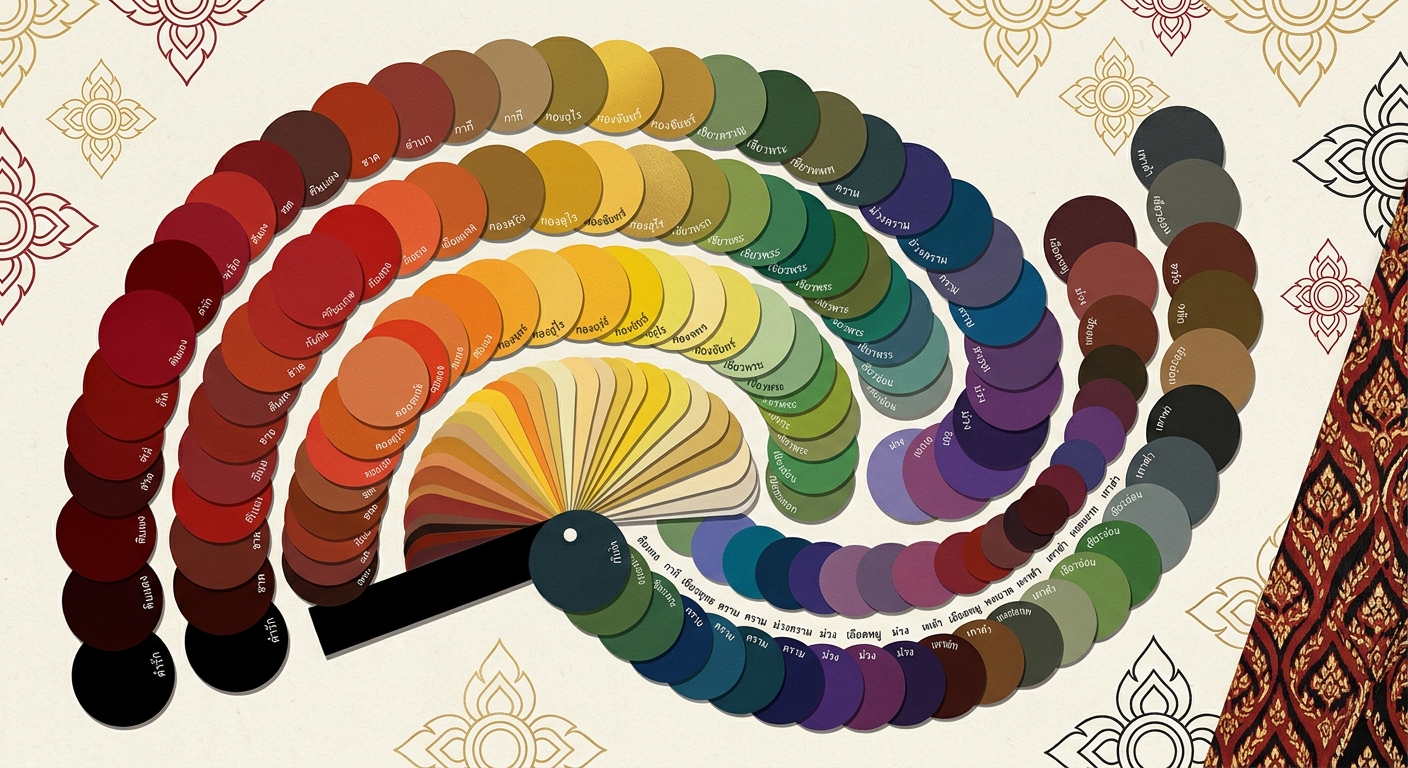
The Thaitone system documented by Dr. Pairoj Pittayamatee (Chulalongkorn University Press, 2012) catalogues 168 traditional Thai colors with CMYK/RGB/HSL values, organized into nine color families. It is the most comprehensive cultural color reference for Thai design work and is the primary sourcing system for ThaiGraph’s color directory at /colors/thaitone/.
The nine families:
- Daeng — reds, 21 variants
- Som — oranges, 14 variants
- Lueang — yellows, 18 variants
- Khiao — greens, 19 variants
- Fa — blues, 22 variants
- Muang — purples, 15 variants
- Khram — indigos, 8 variants
- Thong — golds, 14 variants
- Khao + Dam — whites and blacks, 37 variants
For a brand designer the working subset is 24 colors — the most culturally cited members of each family. That subset is covered in the companion tutorial Building a Thai Design System in Figma. The full 168 are indexed at /colors/thaitone/ with their cultural context, traditional applications, and modern usage examples.
How to make informed color decisions
Five practical questions answer most Thai brand color decisions: What is the brand’s ceremonial register? Does the audience include a royal-adjacent or religious association? What weekday or festival is the campaign tied to? Is the color being used structurally or decoratively? Have you checked a real Thaitone reference rather than an approximated Western palette? These five questions cover the cases where misuse is most visible.
The working practice of Bangkok brand designers — KBTG, Sanook, Farmto, Thai brand studios generally — is to start every project with a Thaitone-sourced palette for the hero color, then build out secondary and tertiary colors with less culturally loaded selections. The hero color carries the cultural signal; the supporting palette gives the brand room to be modern. This pattern produces brands that read as distinctly Thai without tipping into tourism aesthetics.
Keep reading
Individual color pages live at /colors/thaitone/ — each of the 168 colors has its own page with cultural context, hex/rgb/cmyk values, and traditional usage examples. Curated palettes by mood and industry at /colors/palettes/. For the gold family specifically, see /colors/thaitone/temple-gold/. For the typography that pairs with Thai color systems, the pillar is Complete Guide to Thai Typography. For pattern-color interactions, Thai Pattern Library. For brand applications, the /learn/branding/ section.
Information verified as of April 2026
Sources
- The Thai weekday color system assigns a specific color to each day of the week, derived from the colors of the Hindu deities presiding over each day: Sunday-red, Monday-yellow, Tuesday-pink, Wednesday-green, Thursday-orange, Friday-blue, Saturday-purple.—Fine Arts Department, Ministry of Culture, Thailand — Traditional Thai Calendar and Color Correspondences (FAD Cultural Bulletin, 2019) (accessed Apr 7, 2026)
- The Thaitone system documented 168 traditional Thai colors organized into nine families, establishing the most comprehensive cultural color reference for Thai design.—Pairoj Pittayamatee's Thaitone research, Silpakorn University — as documented by the Thai Ministry of Culture in สีไทยโทน (Thai Tone Colour), 2015 (accessed Apr 9, 2026)
- Yellow is the color of King Rama IX (born on a Monday) and has served as the unofficial color of Thai monarchy since the early 20th century; it remains protected by informal cultural convention from casual commercial use.—Royal Thai Government Public Relations Department — Protocol on Royal Colors, 2021 (accessed Apr 8, 2026)
- Thai Buddhist saffron orange (used on monks' robes) is reserved by cultural convention and is not used for commercial branding; adjacent orange tones are acceptable.—Office of National Buddhism, Thailand — Guidelines on Religious Visual Elements, 2020 (accessed Apr 8, 2026)
- Thaitone red (Daeng Chad, #D62828) is documented as the canonical Thai ceremonial red, tracing to late Ayutthaya period lacquer traditions.—Stratton, C. (2004). Buddhist Sculpture of Northern Thailand. Silkworm Books. (accessed Apr 7, 2026)
- Thai funeral ceremonies use black and white; traditional Thai weddings use red and gold; neither palette is appropriate for the other context.—Bradley, D. (2008). Thai Ritual and Ceremonial Paper: A Historical Survey. Silkworm Books. (accessed Apr 5, 2026)