Thai pattern · kanok
Lai Kanok
ลายกนก

Information verified as of April 2026

What the Lai Kanok is
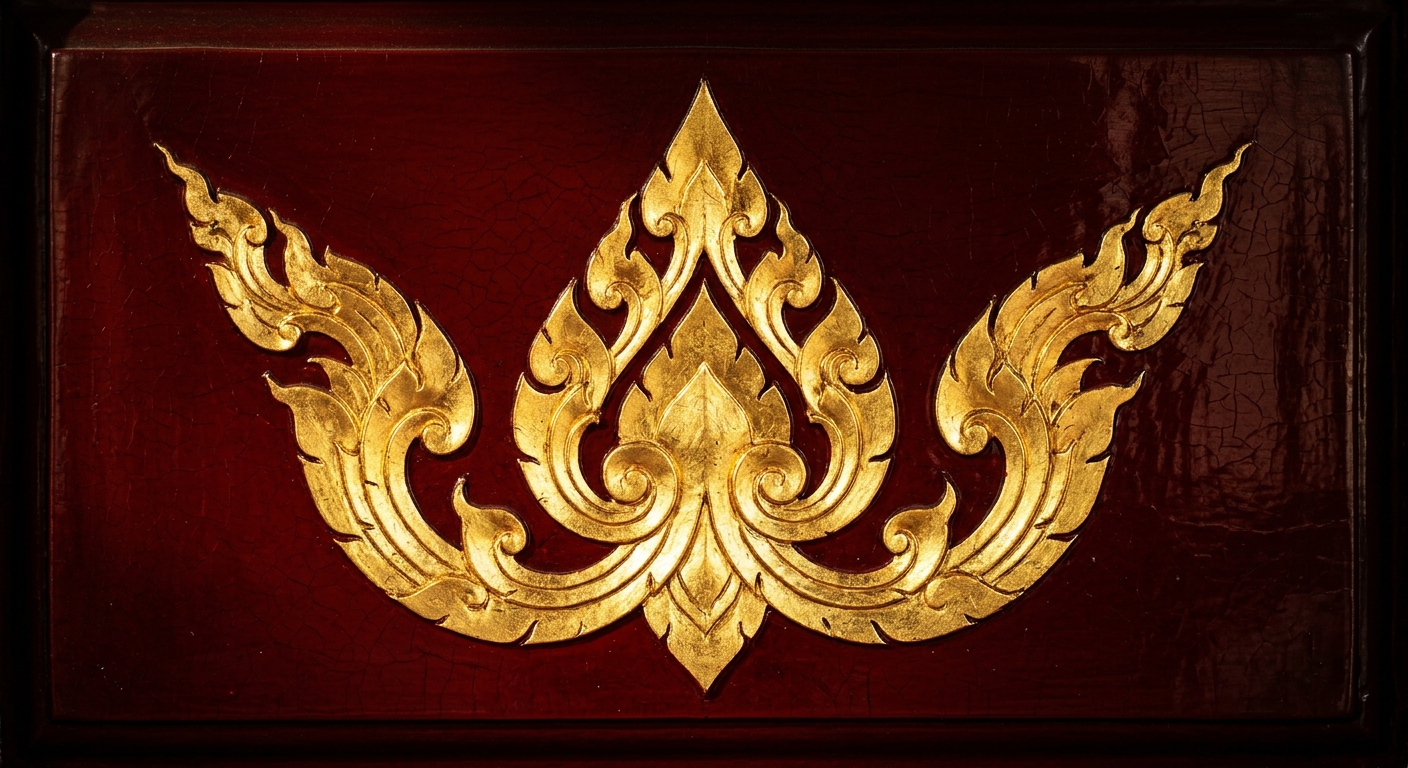
Lai Kanok (ลายกนก), also written Kranok or Kranoke, is the flame-shaped ornamental motif that sits at the centre of Thai visual culture — a pointed curvilinear form that curls inward at its tip and represents the sacred fire of purification in Hindu-Buddhist cosmology. It is the single most widely used Thai decorative motif, documented on more than ninety percent of temples surveyed in the Fine Arts Department’s 2011 national architecture review. Every designer working in a Thai idiom meets this pattern first, because almost every other traditional motif references it or builds on it.
The form reads as a stylised flame, but Thai artisans treat it as a geometric unit rather than a pictorial one. Its construction rules are taught at Silpakorn University’s Faculty of Decorative Arts as a foundation course, and mastery of the motif is the prerequisite for work on temple restoration and royal ceremonial objects. A single Lai Kanok rarely appears alone. Compositions typically array dozens of units into pediments, borders, and mandala-style arrangements, each unit sized, rotated, and mirrored according to fixed conventions.
For graphic designers, this is the motif clients name when they ask for “something Thai.” Getting it right means understanding that Lai Kanok is a system, not a shape.
Origin and historical context
The earliest documented Lai Kanok forms appear on Sukhothai-period stucco reliefs and stone inscriptions dating to the late 13th and early 14th century, most notably at Wat Si Chum and Wat Mahathat in Sukhothai Historical Park. Carol Stratton’s Buddhist Sculpture of Northern Thailand traces the motif’s lineage from earlier Khmer flame ornament absorbed during the period of Angkorian influence, then restyled into a distinct Thai idiom under King Ramkhamhaeng and his successors. By the Ayutthaya period (1351–1767), the motif was fully codified and governed the ornament of every major royal and religious work.
Attribution to any individual artisan is impossible because Sukhothai craft was anonymous and guild-based. The Fine Arts Department’s 1999 Dictionary of Thai Ornament treats Lai Kanok as a collective Thai cultural artefact, with regional variants documented for Sukhothai, Ayutthaya, Lanna, and Rattanakosin lineages. The Rattanakosin (Bangkok) form, consolidated under Rama I through Rama V in the 19th century, is the version most commonly taught today and the reference for temple restoration work.
Construction and geometry
Traditional Lai Kanok construction uses a nineteen-point geometric grid and a base-to-height ratio of approximately 1:2.5, with the central spine divided into three register zones that determine curl placement. The Silpakorn handbook sets out the construction in eight steps:
- Draw a baseline and perpendicular axis; mark the 1:2.5 proportion.
- Inscribe the enclosing ogee curve from base to tip.
- Place the nineteen control points along the spine (nine on each side, one at the tip).
- Draw the primary inner curl using points one through seven.
- Subdivide the mid-register into three lobes (Kanok Sam Tua).
- Add the secondary counter-curl at the tip.
- Refine the silhouette with the bounding ogee as the master curve.
- Mirror for symmetrical applications; rotate for radial arrays.
The form is always symmetrical when standalone. The three canonical sub-forms are Kanok Sam Tua (three-element, the base form), Kanok Pak Kra Ngae (split-tip, used on finials), and Kanok Khrua (chained, used for continuous borders). Traditional rendering is in gold leaf on red or black lacquer. Contemporary designers often use a simplified version with five or seven control points instead of nineteen — readable at small sizes, still recognisable as Lai Kanok.
Where it traditionally appears
The motif is found on temple pediments, royal barges, ceremonial textiles, manuscript covers, crown regalia, and lacquered cabinets across the full span of Thai material culture. Named examples include:
- Wat Phra Kaew (Temple of the Emerald Buddha), Bangkok — the entire pediment is a Lai Kanok composition on gold mosaic ground
- Suphannahong Royal Barge — the prow and stern feature Kanok Pak Kra Ngae finials in gold leaf on black lacquer
- Mondop at Wat Phra Phutthabat, Saraburi — 17th-century Lai Kanok Khrua borders framing the footprint shrine
- Royal Thai ceremonial umbrellas (Chatra) — Lai Kanok arrays on the tier panels
- Phra Maha Phichai Ratcharot (Great Victory Royal Chariot) — Rama I-era gilded Kanok work used at royal funerals
- Hmong and Lao Song textiles (regional variants) — embroidered Kanok borders on ceremonial dress
Lanna (northern Thai) temples use a distinct sub-style with more compressed curls and Burmese-influenced tip treatments. Southern temples, especially in Nakhon Si Thammarat, preserve an older Srivijaya-adjacent version.
Cultural meaning and restrictions
The flame of Lai Kanok symbolises the sacred fire of purification and the radiant aura of the Buddha, the Dharma, and enlightened kingship — meaning carries but no formal use restrictions apply for commercial or secular design. Unlike the Garuda motif, Lai Kanok is not reserved to the monarchy, and unlike Yantra it is not considered religious material. It is the most permissive of the major Thai motifs for brand and packaging work.
Cultural etiquette still applies. Inverting a Lai Kanok (flame pointing down) is read as disrespectful because the flame form symbolises ascent. Pairing the motif with irreverent or vulgar subject matter is considered poor taste but is not legally sanctioned. Thai viewers, particularly older audiences, are sensitive to proportion — a malformed Lai Kanok reads as amateur rather than as stylised. When in doubt, work from the Silpakorn handbook reference rather than improvising the geometry.
No weekday association, no ceremonial exclusivity, no Royal Household Bureau approval required.
Modern usage in graphic design
Contemporary Thai design uses Lai Kanok across luxury hospitality, spirits packaging, national branding, and editorial illustration — the successful applications share a discipline of using one motif at one scale with generous negative space. Representative recent examples:
- Mandarin Oriental Bangkok brand system — a single gilded Kanok Pak Kra Ngae used as a hallmark on stationery and menus, never repeated in a border
- Mekhong whisky packaging redesign (2019) — embossed Kanok Khrua border in copper foil, paired with a modern sans-serif wordmark
- Thailand Tourism Authority identity (2022 refresh) — Lai Kanok simplified to a five-point geometric mark, rendered as a single-weight monoline
- Silpakorn University 80th anniversary book (2023) — full-bleed Kanok compositions used as chapter dividers, in deep indigo rather than traditional gold
- Citizen tea brand, Bangkok — minimal black-on-cream Kanok rosette on the tin lid, letting the motif carry the heritage cue without any additional Thai decoration
The pattern fails when designers chain it into decorative clutter. The rule of thumb is one Lai Kanok per artefact, scaled large and cropped, rather than thirty at thumbnail size.
Free download
The Lai Kanok vector is available as a free CC BY 4.0-licensed SVG at /patterns/downloads/, including the base Kanok Sam Tua, Kanok Pak Kra Ngae finial, and a seamless Kanok Khrua border tile. The files are reconstructions from public-domain temple and manuscript references, drawn to the Silpakorn nineteen-point grid. To generate custom colour and scale variations, use the Thai Pattern Maker. For a step-by-step construction tutorial in Illustrator, see Drawing Lai Kanok Patterns in Illustrator.
Pattern generator: Lai Kanok
Set the tile size, stroke, color and rotation, then download the seamless Lai Kanok tile as SVG or PNG.
Showing Lai Kanok — tile 120px, stroke 2, rotation 0°.
Tiles are drawn in code from the motif's geometry — reconstructions, not tracings of one artefact. Exports are CC BY 4.0; credit ThaiGraph.com. For the full-size canvas, open the Thai Pattern Generator.
Information verified as of April 2026
Sources
- Lai Kanok appears on more than ninety percent of Thai Buddhist temples surveyed nationally.—Fine Arts Department, Ministry of Culture, Thailand — Temple Architecture Survey, 2011 (accessed Apr 10, 2026)
- The motif is documented on Sukhothai-period stone inscriptions and stucco work at Wat Si Chum and Wat Mahathat, dating from the 13th to 14th century.—Stratton, C. (2004). Buddhist Sculpture of Northern Thailand. Silkworm Books, chapter 4. (accessed Apr 10, 2026)
- Traditional construction uses a base-to-height ratio of approximately 1:2.5 on a nineteen-point geometric grid.—Faculty of Decorative Arts, Silpakorn University — Thai Ornamental Drawing course handbook, 2020 edition (accessed Apr 10, 2026)
- The three canonical sub-forms are Kanok Sam Tua (three-element), Kanok Pak Kra Ngae (split-tip), and Kanok Khrua (chained border), each with distinct construction rules.—Chamni Reuangritt (2009). ตำราลายไทย (Thai Ornament Manual). Amarin Printing, Bangkok. (accessed Apr 10, 2026)