Thai pattern · mek-lai
Mek Lai
เมฆลาย

Information verified as of April 2026
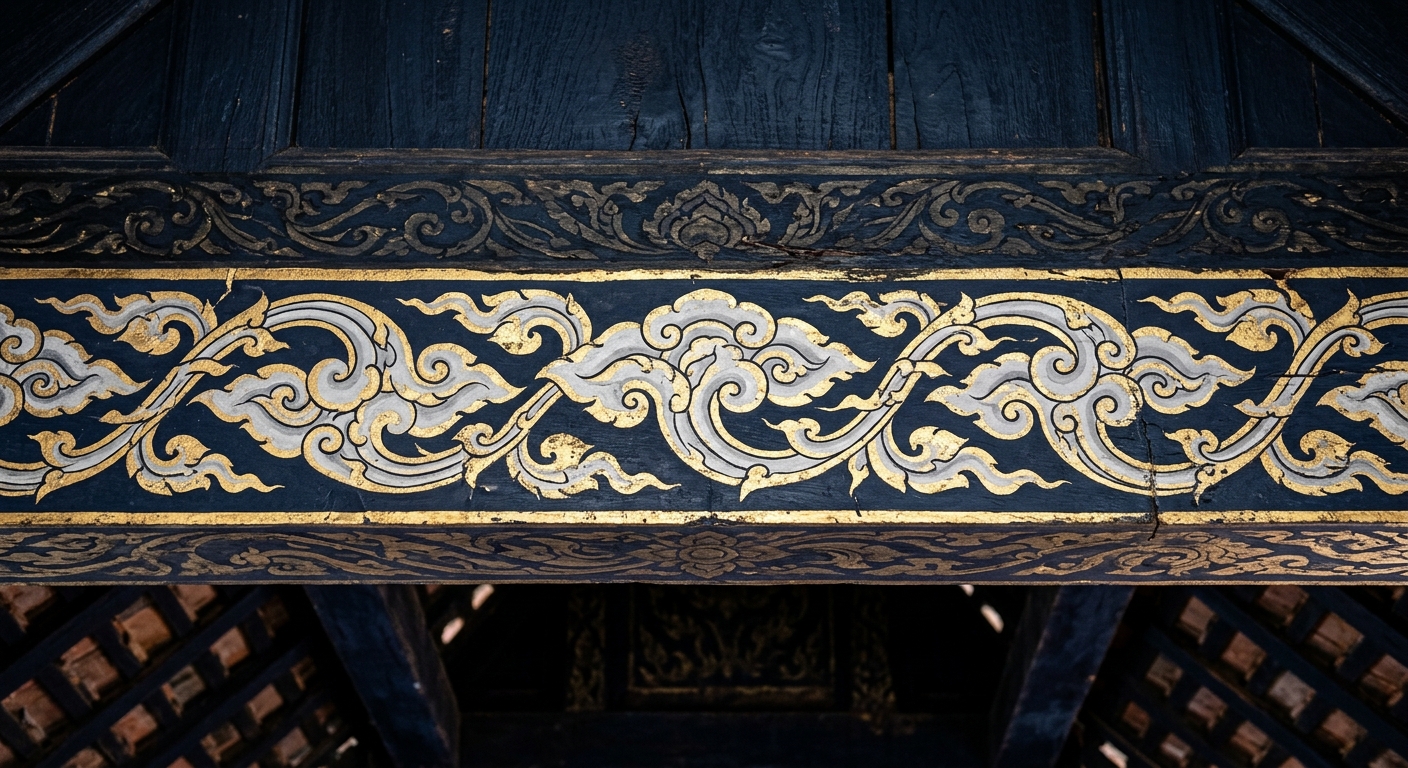

What the Mek Lai is
Mek Lai (เมฆลาย) is the stylised cloud motif of traditional Thai ornament — a rolling spiral form typically arrayed in horizontal bands on temple ceilings, royal robes, and manuscript borders, representing the heavenly realm and the auspicious cloud-paths travelled by celestial beings. The name literally means “cloud pattern” (เมฆ mek = cloud, ลาย lai = pattern). Unlike the flame-based Lai Kanok, Mek Lai is a soft, flowing motif, and it reads as calm and elevated rather than active or sacred-radiant.
The form is immediately recognisable but often misread. Designers unfamiliar with the tradition assume the spirals are purely decorative and rearrange them freely. In fact, Mek Lai units are built to a specific nested-spiral rule and always move in a single directional flow within a band — reversing the flow mid-band is a visible error to Thai viewers.
Origin and historical context
Mek Lai is an Ayutthaya-period adaptation of the Chinese ruyi (如意) cloud motif, absorbed through the port trade of the 14th to 17th century and restyled into a distinct Thai vocabulary. Piriya Krairiksh’s Roots of Thai Art documents the transmission through the large Chinese merchant community resident in Ayutthaya and through diplomatic gifts exchanged between the Siamese and Ming courts.
The Thai version diverges from its Chinese source in three ways. The Thai spiral count is fixed at three or five units per cloud head (the Chinese ruyi uses variable counts). The trailing tail is shaped into a Kanok-adjacent curl (Chinese ruyi tails are simple). And the Thai motif is used structurally as a band element rather than decoratively as a standalone symbol.
By the early Rattanakosin period (late 18th century), Mek Lai had been absorbed fully into the Thai ornamental canon and was being painted on temple ceilings as a separate decorative register distinct from the figurative murals below. The Office of Traditional Arts’ conservation handbook records the technique and pigment conventions used from the Ayutthaya period onward.
Construction and geometry
A standard Mek Lai unit consists of a cloud head with three or five nested spirals, a curled trailing tail shaped into a Kanok-style hook, and a fixed orientation within the horizontal band. The construction rules:
- Set a baseline and a ceiling line defining band height.
- Mark unit widths at one-and-a-half times the band height (the 1:1.5 proportion).
- Draw the cloud head as three or five nested C-curves, opening in a single direction (left or right per band).
- Add the trailing tail as a Kanok-style curl at the base.
- Connect units tail-to-head with a continuous undulating spine.
- Colour the cloud head with tonal shading (lighter inside, darker outside) to read as volumetric.
Spirals always nest concentrically. Each spiral is a simple C-curve, not a logarithmic or Fibonacci spiral, and the nesting ratio between adjacent spirals is approximately 1:1.6. The three-spiral form is used on manuscript borders and narrow bands. The five-spiral form is reserved for ceilings and large textile panels.
A rarer variant, Mek Lai Kranok, fuses the cloud head with a Kanok tip and is used at the corners of ceiling panels to turn the band direction.
Where it traditionally appears
Mek Lai dominates temple ceilings of the Ayutthaya and Rattanakosin periods, royal court robes, manuscript cabinet borders, and monastic ceremonial fan covers. Reference sites and objects:
- Wat Suthat, Bangkok — the coffered ceiling of the ordination hall is divided into panels, each with a full Mek Lai band in gold leaf on cinnabar
- Wat Ratchabophit, Bangkok — Rama V-era Mek Lai work on the doorway arches and interior cornices, documented in the Ministry of Culture conservation record
- Wat Phra That Doi Suthep, Chiang Mai — Lanna-style Mek Lai on the ubosot ceiling with compressed spiral counts
- Royal court chut thai chakkri dress — woven Mek Lai bands as rank markers on court robes, examples preserved at the Queen Sirikit Museum of Textiles
- Manuscript cabinet (1776, Rama I) — National Museum Bangkok collection, black-lacquer cabinet with full Mek Lai corner-turn bands in gold leaf
- Monastic talipot fan (พัดยศ), 19th century — ceremonial fans carried by abbots feature embroidered Mek Lai borders
Lanna temples show compressed, more angular Mek Lai with Burmese influence. Central Thai temples (Bangkok, Ayutthaya) preserve the canonical rolling-spiral form.
Cultural meaning and restrictions
Mek Lai symbolises the heavenly realm, auspicious weather, and the travel-paths of celestial beings, and carries no formal use restrictions for commercial or secular design. It is among the most permissive Thai motifs for brand work. The cloud reading is universally positive in Thai visual culture — clouds signify rain (agricultural blessing), elevation (monastic merit), and the celestial register (auspicious association).
No weekday association applies. No Royal Household Bureau approval is required. The motif is not considered religious material in the way Yantra is, because it functions as a decorative register rather than a sacred form.
The only etiquette issue is directional flow. In traditional compositions, Mek Lai bands flow in a single direction within a register. Mixing directions within a band reads as chaotic to Thai viewers familiar with the convention, similar to how mixed kerning styles read as amateur in Western typography.
Modern usage in graphic design
Contemporary Thai design uses Mek Lai most often in luxury hospitality, wellness, and premium packaging, where the brief calls for “Thai but restrained” — the cloud form signals elevated heritage without reading as religious or overtly royal. Representative recent examples:
- The Siam Hotel, Bangkok — Mek Lai bands used as a horizontal keyline on room stationery and guest directories, rendered in a single muted blue
- Karmakamet incense brand — simplified three-spiral Mek Lai on the tin lids of the premium incense line, debossed rather than printed
- Thai Airways Royal Silk Class amenity kits (2022) — Mek Lai textile bands translated into embroidered accents on the kit bag
- Anantara Resorts spa product line — Mek Lai corner ornaments on bottle labels, printed in copper foil on ivory
- SOOK Siam (ICONSIAM food hall) branding — Mek Lai used as a wayfinding graphic element, scaled large and cropped to form section dividers
The motif works in modern applications because its flowing form pairs naturally with contemporary typography. It fails when designers use it at small decorative scale — three-spiral Mek Lai below 24 pixels high reads as visual noise.
Free download
The Mek Lai vector pack on /patterns/downloads/ includes the three-spiral band, five-spiral band, and Mek Lai Kranok corner-turn unit as CC BY 4.0 SVG and AI files. The units tile seamlessly and include construction-grid overlays for reference. To generate custom colour variations matching a Thaitone palette, use the Thai Pattern Maker. For the broader cloud, floral, and Kanok vocabulary in context, see the Thai pattern index.
Pattern generator: Mek Lai
Set the tile size, stroke, color and rotation, then download the seamless Mek Lai tile as SVG or PNG.
Showing Mek Lai — tile 120px, stroke 2, rotation 0°.
Tiles are drawn in code from the motif's geometry — reconstructions, not tracings of one artefact. Exports are CC BY 4.0; credit ThaiGraph.com. For the full-size canvas, open the Thai Pattern Generator.
Information verified as of April 2026
Sources
- Mek Lai was adapted from Chinese ruyi cloud ornament during the Ayutthaya period (14th–17th century) and restyled into a distinctly Thai spiral vocabulary.—Piriya Krairiksh (2012). The Roots of Thai Art. River Books, Bangkok — chapter on Ayutthaya decorative arts (accessed Apr 10, 2026)
- The standard Mek Lai unit nests three or five spirals within a single cloud head, with the trailing tail forming the connective element in horizontal bands.—Fine Arts Department, Ministry of Culture, Thailand — Dictionary of Thai Ornament, 1999 edition (accessed Apr 10, 2026)
- Traditional Mek Lai colouring uses pale blue (khiao khai), grey, and gold leaf on a cinnabar or indigo ground, documented on Ayutthaya and Rattanakosin temple ceilings.—Office of Traditional Arts, Ministry of Culture — Thai Mural Conservation Handbook, 2016 (accessed Apr 10, 2026)
- Royal robes of the Ayutthaya and early Rattanakosin periods use woven Mek Lai bands as rank markers, documented in the Queen Sirikit Museum of Textiles collection.—Queen Sirikit Museum of Textiles, Bangkok — Royal Court Dress exhibition catalogue, 2018 (accessed Apr 10, 2026)