Thai font · OFL
KoHo

Information verified as of June 2026
อ่านหน้า ฟอนต์ KoHo เป็นภาษาไทย — พร้อมลิงก์ดาวน์โหลดและวิธีติดตั้ง →
How to install & use
- Windows — Download the .zip, unzip it, then right-click the .ttf/.otf file → “Install”.
- macOS — Double-click the .ttf/.otf file, then click “Install Font” in Font Book.
- Web — Embed from Google Fonts with a <link> tag or @import — grab the snippet on the specimen page.
Try KoHo
Type your own text to preview KoHo live. Adjust size and weight, then grab the embed code.
What KoHo is
KoHo is a looped Thai and Latin sans drawn by a three-person studio of the same name in Khon Kaen — Kham Chaturongkhakun, Kanokwan Phaenthaisong, and Khanittha Sitthiyaem — and distributed through Cadson Demak on Google Fonts since August 2018. Six weights from ExtraLight (200) to Bold (700), each with a true italic, all under the SIL Open Font License.
Two official descriptions exist, and they disagree in a useful way. The Google Fonts specimen calls KoHo a family “inspired by geometric and humanist san serifs” that appears “neither too mechanical or too calligraphic” and works for both text and display. The project README is blunter: a display face with “a charm of vernacular and carefree handmade typeface,” a deliberate nod to what it calls the “unfashionable countryside and folk way of life” of rural, agricultural Thailand. Both are accurate. The skeleton is a tidy modern sans. The detailing is country.
Character design and tone
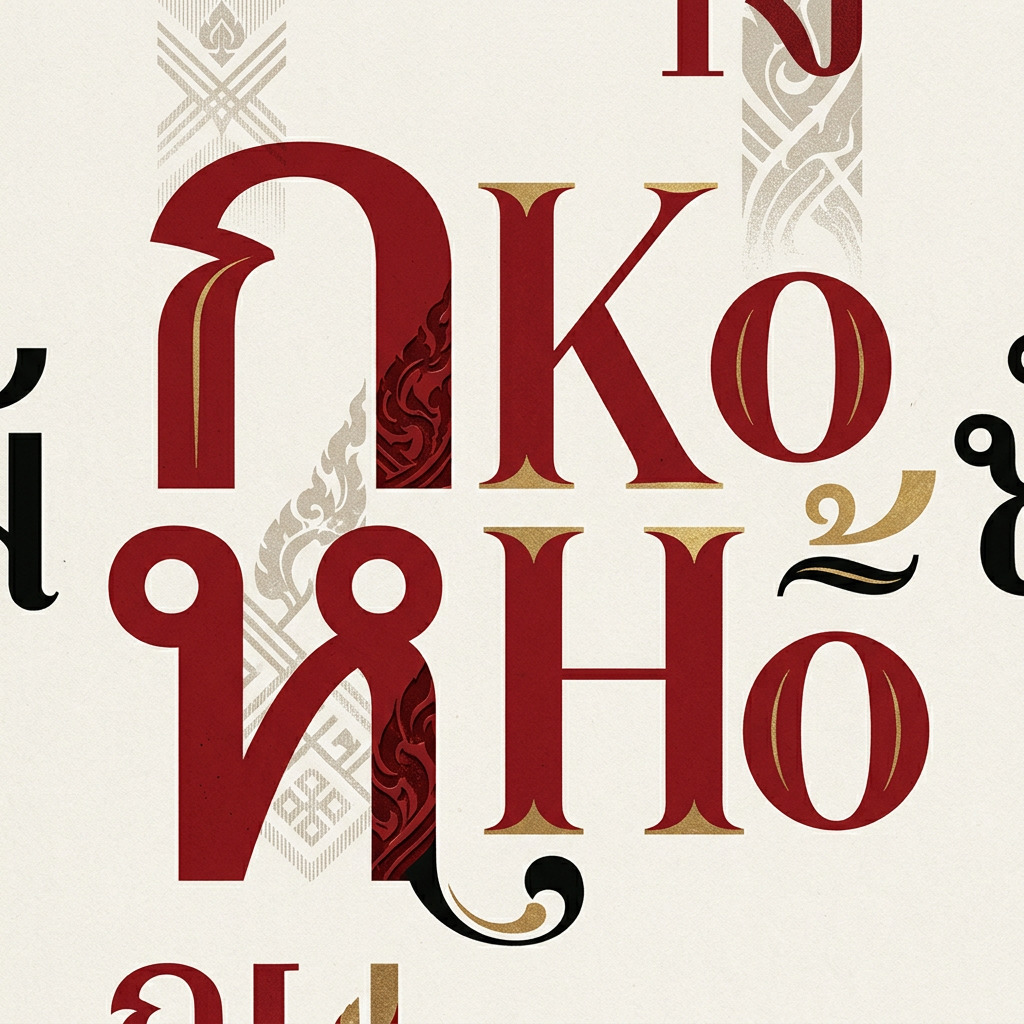
KoHo’s signature decision is inconsistency on purpose: organic forms were “randomly applied to the head loop through out the whole set,” per the project README, so the loops (หัว) on ม, ถ, and ภ do not quite match each other. Most looped Thai fonts treat the head as a precision element. KoHo treats it like a potter’s thumbprint.
At poster sizes the unevenness reads as handmade warmth. At 14px it flattens into ordinary texture, which is the practical reason Google Fonts can honestly position the family for text use as well as display. The strokes stay close to monolinear and the structure stays geometric, so paragraphs hold together even while individual heads wobble.
Latin, Latin Extended, and Vietnamese ship alongside the Thai set, which matters for menus and packaging that mix scripts on one surface.
Weights and availability
KoHo ships twelve static styles on Google Fonts: six weights from ExtraLight (200) to Bold (700), each with a matching italic. No variable-font version is listed. True italics across every weight remain unusual among free looped Thai families; KoHo commits to them throughout.
Regular and SemiBold cover most signage and menu work. ExtraLight is fragile below display sizes — the thin loops lose their character first.
How to download KoHo
KoHo is a free download from Google Fonts — the family ZIP contains all twelve static TTFs, no registration required. Three routes:
- Google Fonts ZIP — open the KoHo specimen, click “Get font”, and download the family ZIP.
- CSS embed — load
https://fonts.googleapis.com/css2?family=KoHo:ital,wght@0,400;0,600;1,400&display=swapin a<link>tag, then setfont-family: 'KoHo', sans-serif;. - GitHub source — the cadsondemak/Koho repository holds the project files for self-hosting.
Best use cases
KoHo fits friendly, local, food-adjacent briefs — the kind of work where a polished corporate sans would feel like a costume. Strong briefs:
- Café, street-food, and market branding: menus, stall signage, delivery packaging
- Community festival posters and local event material
- Packaging for agricultural products and small-batch goods
- Editorial features on rural Thailand and Thai food writing
Where it does not fit: corporate identity systems, fintech UI, and long technical documents. The loop inconsistency that gives KoHo its charm becomes noise in a data table. For quiet body text under KoHo headers, Sarabun does the unglamorous work.
Pairings
KoHo pairs best with quieter Thai faces that let its uneven loops stay the point.
- Sarabun — the loopless workhorse for body text under KoHo display; see Sarabun
- Prompt — geometric loopless sans when subheads need a cleaner modern counterweight; see Prompt
For looped alternatives with steadier heads, compare Krub and Niramit. The Thai typography guide covers pairing logic; the fonts directory has the full catalogue.
Licensing
KoHo is released under the SIL Open Font License: free for commercial use, modification, web embedding, and bundling, provided the OFL notice travels with the files. Copyright sits with The KoHo Project Authors. Verify at the Google Fonts specimen or the GitHub repository. A restaurant can put KoHo on every menu, sign, and delivery box without paying anyone.
Frequently asked questions about KoHo
Is KoHo free for commercial use?
Yes — KoHo is free for both personal and commercial use under the SIL Open Font License (OFL). You can use it in client work, apps, products, and websites at no cost, and self-host or embed it from Google Fonts. The only OFL condition is that you don’t sell the font files on their own.
How many weights does KoHo have?
KoHo ships in 6 weights: ExtraLight, Light, Regular, Medium, SemiBold, Bold. Pick a heavier weight for display and headlines, and a Regular or lighter weight for body text and long-form reading.
Does KoHo support Latin and English characters?
Yes — KoHo includes a Latin character set alongside Thai, so it can set English and Thai in one typeface. That makes it a practical choice for bilingual branding, packaging, and UI.
Where can I download KoHo?
Download KoHo free from Google Fonts. You can install the desktop files, self-host the WOFF2 files, or embed it directly with a <link> tag or @import — grab the embed code from the live preview above.
What fonts are similar to KoHo?
The closest alternatives to KoHo are Krub, Niramit, K2D. They share a similar style and use case, so they’re the first faces to compare if you need a different weight range, license, or price.
Who designed KoHo?
KoHo was designed by Kham Chaturongkhakun, Kanokwan Phaenthaisong, Khanittha Sitthiyaem (KoHo studio) at Cadson Demak, released in 2018. Full designer credit and the primary source are listed at the bottom of this page.
Information verified as of June 2026
Sources
- KoHo is distributed on Google Fonts under the SIL Open Font License with six weights from ExtraLight (200) to Bold (700), each with a matching italic, added in August 2018.—Google Fonts metadata for KoHo (google/fonts repository) (accessed Jun 13, 2026)
- KoHo was designed at a small studio of the same name in Khon Kaen by Kham Chaturongkhakun, Kanokwan Phaenthaisong, and Khanittha Sitthiyaem, with organic forms applied randomly to the head loops.—KoHo project README, Cadson Demak GitHub (accessed Jun 13, 2026)
- Google Fonts describes KoHo as inspired by geometric and humanist sans serifs, neither too mechanical nor too calligraphic, working for both text and display.—Google Fonts specimen page for KoHo (accessed Jun 13, 2026)