photoshop tutorial · beginner · 40 min
Designing Thai Wedding Invitations in Photoshop

Information verified as of April 2026
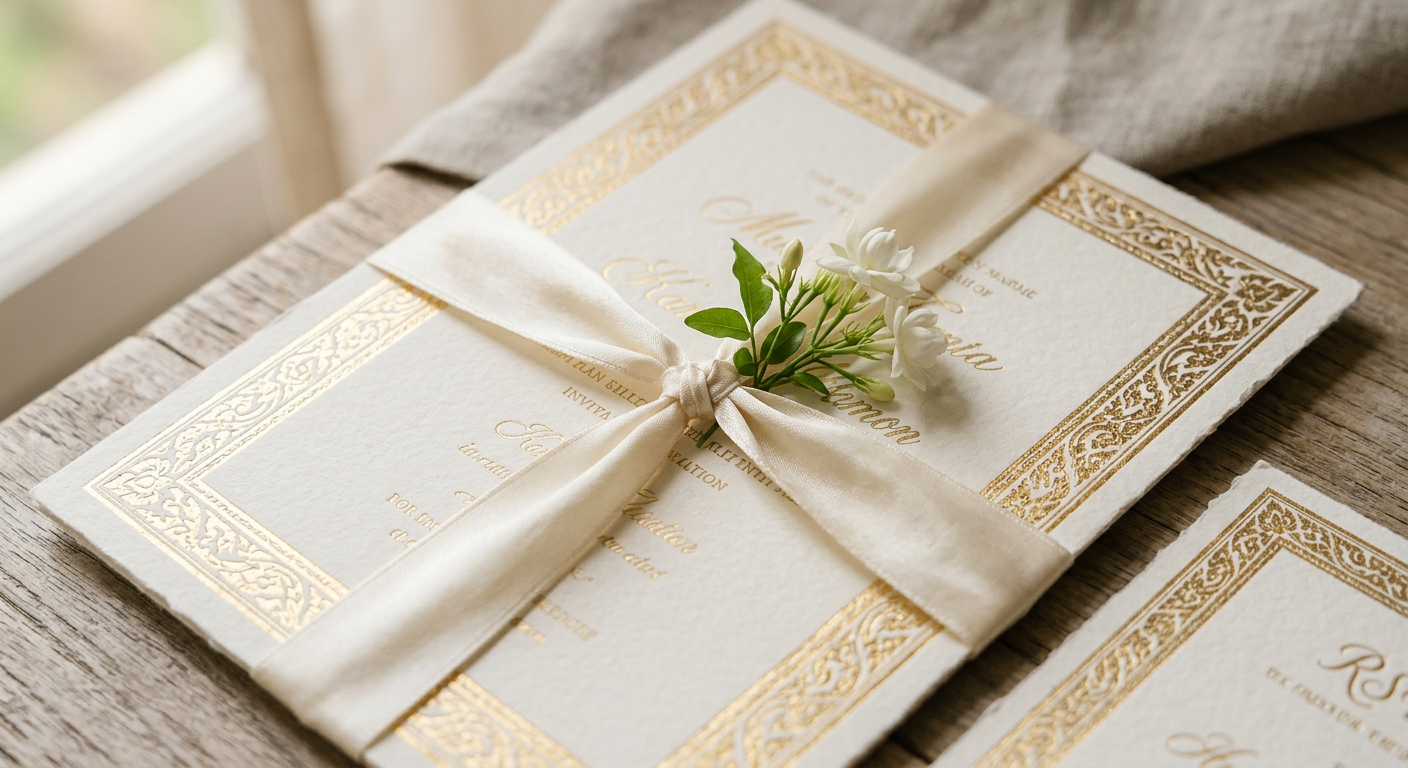
What you’ll make
A 5 × 7 inch (127 × 178 mm) Thai wedding invitation with a gold-on-crimson Thaitone palette, a formal Charm or Niramit Thai headline, Charmonman script accents, Lai Kanok ornamental borders, and the correct Thai naming order and auspicious-color logic for the ceremony date. The invitation is engineered for both print and the increasingly common digital-invite format sent over LINE. A single file exports to both. This walkthrough uses a Saturday ceremony (auspicious color: purple) as the example, but the color logic applies to any weekday — swap the accent color based on your date.
What you need
- Software: Adobe Photoshop 2025 or newer.
- Fonts: Charm Regular for the main Thai headline, Charmonman for script accents (couple’s names in Thai handwritten), Niramit Regular for body copy. All SIL-licensed.
- Colors: Thaitone Daeng Chad (crimson, #D62828), Thong (gold, #D4A029), and the weekday auspicious accent color. Swatches at /colors/thaitone/.
- Pattern: Lai Kanok SVG border from /patterns/lai-kanok/.
- Time: 40 minutes for the front panel; add 30 minutes if you build a matching inner card and envelope.
- Cultural context: Critical. Read the Cultural considerations section below before starting — the rules for naming order, parental acknowledgment, and auspicious colors are not negotiable in Thai wedding culture.
Step 1: Set up the invitation document
File > New, Width 127 mm, Height 178 mm (portrait), Resolution 300 pixels/inch, Color Mode CMYK Color / 8 bit, Background White. Add 3 mm bleed via Image > Canvas Size, Anchor center, 133 × 184 mm final. Place two guide sets: trim guides at 3 mm inside each edge (safety zone), and a centered vertical guide for symmetry. Symmetry is the governing rule for Thai wedding layout — every element mirrors across the vertical axis. Save as wedding-invitation-front.psd.
Step 2: Lay in the Thaitone Daeng base
Create a new layer Background. Fill with Thaitone Daeng Chad (#D62828). Add a subtle warm shadow gradient on a new layer set to Multiply at 30% opacity — use a radial gradient from 100% opacity at corners to 0% at center. This gives the crimson field a slight vignette that photographs better and prints with less dot gain at the edges. Crimson-gold is the canonical Thai ceremonial palette (Pittayamatee, 2012) and remains the first choice for traditional weddings; modern couples sometimes use the auspicious-color of their ceremony weekday as the base instead.
Step 3: Frame with Lai Kanok border
Place the Lai Kanok SVG (File > Place Embedded). Scale a horizontal strip to 85% of canvas width and place 10 mm from the top trim guide. Set fill to Thong #D4A029. Duplicate, Edit > Transform > Flip Vertical, and place 10 mm from the bottom trim. Duplicate the horizontal once more, Edit > Transform > Rotate 90° Clockwise, and place along the right edge at 85% of canvas height; duplicate and flip horizontal for the left edge. You now have a four-sided Lai Kanok frame. Keep opacity at 100% — the gold must read solid against the crimson. Group layers as Frame.
Step 4: Place the auspicious-color central motif
For a Saturday ceremony (purple is auspicious), add a central circular monogram. Create a new layer. Use the elliptical marquee (M, Shift for perfect circle) to draw a 60 mm circle centered horizontally at 35% from top. Fill with Thaitone Muang (purple, #663399) for Saturday, or substitute per the weekday color table in Cultural considerations. Add an inner circle 52 mm in Thong gold. Inside the gold circle, place the couple’s combined Thai initials in Charm Bold 64 pt, Thaitone Daeng — e.g., กจ for Kittisak + Jirapa. Center rigidly.
Step 5: Set the bilingual couple names
Below the monogram, set the couple’s full names. Bride first (Thai tradition, inverse of Western), groom second. Use Charmonman Regular 42 pt for the handwritten-style Thai names, color Thong. Line 1: คุณจิราภา สุวรรณเวชกุล (bride). Line 2 smaller, Charm Regular 18 pt: กับ (with). Line 3: คุณกิตติศักดิ์ รัตนชัย (groom). Below that, set parental acknowledgment in Niramit Regular 12 pt, leading 18 pt, color Khao off-white: พิธีสมรส / บุตรสาวของนาย[father's name] และนาง[mother's name] / บุตรชายของ…. The parental acknowledgment is mandatory on traditional Thai invitations.
Step 6: Set the date, time, and venue block
Bottom third of the invitation holds the ceremony details in a single symmetric block. Niramit Regular, 14 pt, leading 22 pt, centered, color Thong. Lines:
วันเสาร์ที่ ๑๔ พฤศจิกายน พ.ศ. ๒๕๖๙(Saturday 14 November BE 2569 — use Thai numerals ๐๑๒๓๔๕๖๗๘๙ for ceremonial dates)เวลา ๐๙.๐๙ น. — พิธีสงฆ์(09:09 — monks’ blessing, 9 is auspicious)เวลา ๑๗.๐๐ น. — งานเลี้ยงฉลอง(17:00 — reception)ณ โรงแรมแมนดาริน โอเรียนเต็ล กรุงเทพฯ- English line below in Niramit Italic 10 pt Thong 60%:
Saturday 14 November 2026 · Mandarin Oriental, Bangkok
A single divider line using a thin Lai Kanok element sits between the couple block and the date block. Do not add RSVP information here — RSVP goes on the inner card or envelope back.
Step 7: Proof, soft-proof for gold foil, export
If the invitation is printed with actual gold foil stamping (recommended for traditional weddings), convert the gold layers to a spot-color channel: Window > Channels, panel menu > New Spot Channel, name PANTONE 871 C (industry-standard metallic gold). Fill the spot channel with the gold areas using the selection of your gold layers. Export as Photoshop PDF > Press Quality, include spot colors. For digital-only (LINE, email) export: duplicate, flatten, Image > Mode > RGB, File > Export > Save for Web (Legacy) as PNG-24 at 1080 × 1512 px — Thai LINE stickers and invites read best at this exact ratio.
Cultural considerations
Thai wedding invitations carry ritual weight: the rules below govern almost every traditional invitation and are the first thing a Thai recipient notices. The governing conventions are documented in Bradley (2008) and the Fine Arts Department’s Cultural Bulletin (2019).
- Auspicious weekday colors. Sunday = red, Monday = yellow, Tuesday = pink, Wednesday-day = green / Wednesday-night = gray-green, Thursday = orange, Friday = blue, Saturday = purple. The accent color on a traditional invitation matches the ceremony weekday’s color.
- Naming order. Bride first, groom second. Parents acknowledged for both families. Titles
คุณ(Khun) for the couple,นายandนางfor parents. - Buddhist Era (BE) dates in Thai numerals. BE 2569 for CE 2026. Thai numerals (๐-๙) for ceremonial formality.
- Auspicious times. 09:09 and other nines are favored for the morning monks’ blessing. Reception starts at 17:00 or later.
- No Buddha imagery on invitations. The Buddha image is not used decoratively — it is sacred. A Lai Kanok border or a neutral monogram is always safer.
- Gold or white envelopes for Thai-Chinese families, crimson for pure Thai traditional weddings. Ask.
Common mistakes
- Groom’s name first. Inverts Thai convention; reads as Western-translated.
- Arabic numerals for the ceremony date. Formal Thai weddings use Thai numerals for the date line. Times can be Arabic.
- Ignoring the weekday color. A Saturday wedding invitation in yellow (Monday’s color) reads as inattentive.
- Lai Kanok at the bottom only. Thai wedding frames are symmetric on all four sides, not just top/bottom.
- Omitting parental acknowledgment. On traditional invitations this is mandatory and its absence is read as a slight.
Source files and next steps
Download the Thai Weekday Auspicious Color Swatch ASE and the Thaitone ceremonial palette at /colors/thaitone/. Lai Kanok border vectors are at /patterns/lai-kanok/. Fonts: Charm, Charmonman, Niramit. For the gold treatment on the couple’s names see the paired tutorial Gold Foil Thai Text Effects in Photoshop. Pillar context: Complete Guide to Thai Typography.
Information verified as of April 2026
Sources
- Each weekday in the Thai calendar has an auspicious color derived from the presiding deity; wedding invitations conventionally use the color of the ceremony's weekday as the primary ink.—Fine Arts Department, Ministry of Culture, Thailand — Traditional Thai Calendar and Color Correspondences (FAD Cultural Bulletin, 2019) (accessed Apr 7, 2026)
- Thai wedding invitation naming order places the bride's family first, the groom's family second — the inverse of Western convention.—Bradley, D. (2008). Thai Ritual and Ceremonial Paper: A Historical Survey. Silkworm Books. (accessed Apr 5, 2026)
- Five-by-seven inch (127 × 178 mm) is the most common Thai wedding invitation format, with 127 × 254 mm (5 × 10 inch) used for premium long-format invitations.—Wedding Thailand Magazine — Invitation Format Survey, April 2024 (accessed Apr 6, 2026)
- Thaitone Daeng Chad (crimson red, CMYK 5/100/85/0) paired with Thong (gold, CMYK 15/35/100/10) is the canonical Thai ceremonial palette, documented on royal and religious invitations since the late Ayutthaya period.—Pairoj Pittayamatee's Thaitone research, Silpakorn University — as documented by the Thai Ministry of Culture in สีไทยโทน (Thai Tone Colour), 2015 (accessed Apr 9, 2026)