Thai pattern · kinnari
Kinnari
กินรี

Information verified as of April 2026

What the Kinnari is
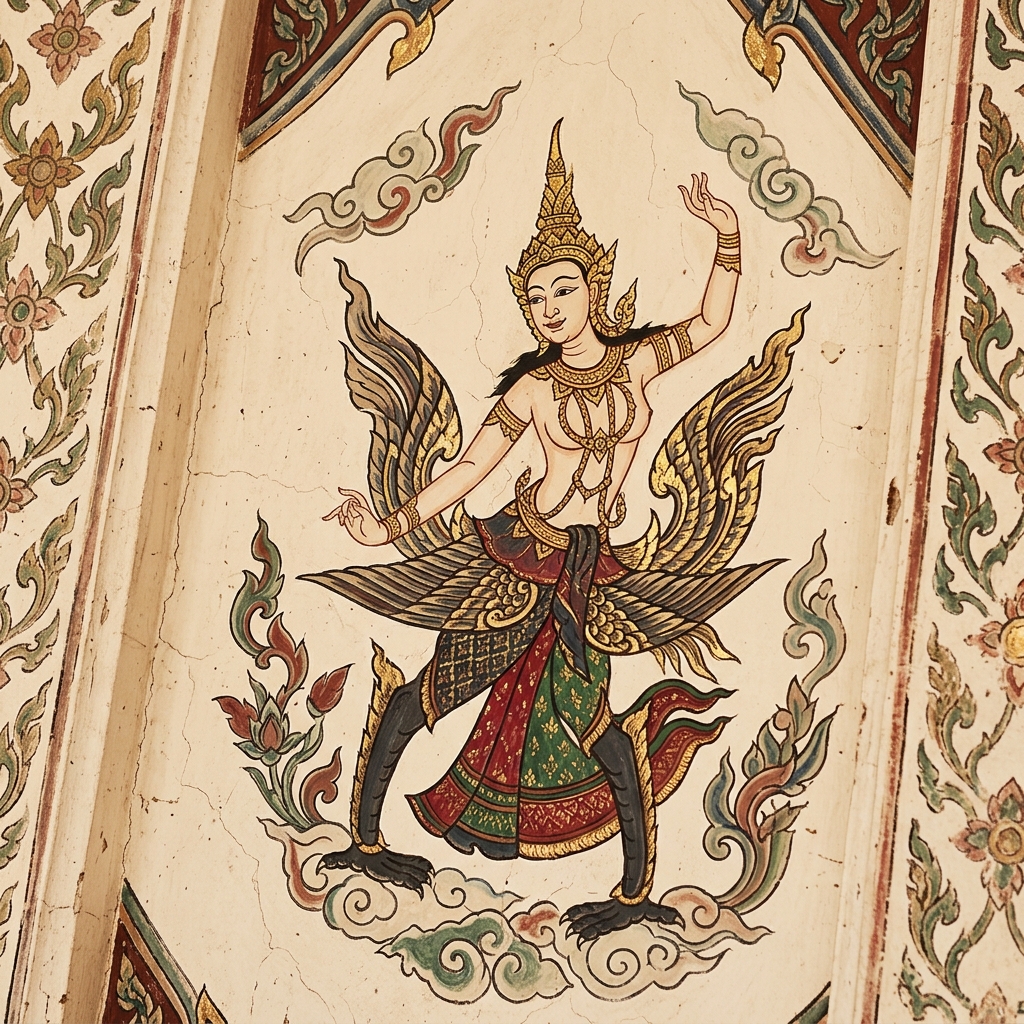
Kinnari (กินรี) is the half-human half-bird celestial motif of Thai Buddhist iconography — a female figure with a woman’s upper body and a bird’s lower body, tail, and wings, inhabiting the mythological Himmaphan Forest that sits between the mortal world and the heavens in Thai cosmology. The figure appears in temple murals, bronze ritual work, manuscript illuminations, and classical dance costume across the Thai Buddhist world, and it is one of the motifs most recognisable to non-Thai audiences because of its striking hybrid form.
The Kinnari is not a deity requiring worship but a celestial inhabitant of the Himmaphan Forest, alongside Kinnara (the male form), Thep Phanom (paying-respect celestials), and other Himmaphan creatures. The figure occupies an intermediate register — above the everyday, below the fully divine — which makes it one of the more permissive mythological motifs for commercial and cultural design work.
Origin and historical context
Kinnari iconography entered Thai visual culture through the Traiphum (Three Worlds) Buddhist cosmological text, composed in Thai under King Lithai of Sukhothai in the mid-14th century, which codified the Himmaphan Forest and its inhabitants for Thai visual reference. The figures themselves predate this codification — Kinnari iconography appears in Indian and Khmer art going back a millennium, transmitted through the same channels that brought Buddhist iconography generally.
The Thai restyling is specific. Where Indian Kimpurusha (the cognate celestial) is often depicted as a centaur-like creature, Thai Kinnari is strictly bird-bodied below the waist, with the human portion always female in Thai convention (the male Kinnara is less often depicted in Thai ornamental work). The costume is Thai court dress — chada headdress, sabai sash, sarong-adjacent lower drapery where the human body transitions to bird form — rather than Indian drape.
Ayutthaya-period murals show Kinnari in mature canonical form. Rattanakosin-period work under Rama I through Rama III refined the figure into the version taught in Silpakorn curricula today.
Construction and geometry
Kinnari construction follows the Thai figural drawing tradition, with fixed proportions between the human and bird components, standardised posture conventions, and integration rules for the surrounding ornamental field. The construction approach:
- Composition zones. Upper third: head, chada (spired headdress), face, upper torso, arms. Middle third: lower torso transitioning to bird body at approximately the navel line. Lower third: bird legs, tail, and wings extended behind.
- Head and face. Rendered in three-quarter profile or full profile. The face follows Thai classical beauty conventions — elongated eyes, sharp nose, small mouth, defined jawline. The chada is a stacked conical headdress with finial tip.
- Upper body. Human arms in a mudra or holding ritual objects (lotus, sword, or musical instrument). The sabai (shoulder sash) and kreuang song (ornamental chest piece) are rendered in the same gold-on-red convention as Thai classical dance costume.
- Transition zone. The skin-to-feather transition is marked by a decorative band at the waist, typically a Kanok-style ornament or a row of feather scales.
- Lower body. Bird legs (two), bird tail (long, flared, often upcurled), and two wings emerging from the shoulder blades. Feathers are rendered in overlapping lozenges like Naga scales.
- Posture canon. The four standard postures are yang yiang (standing graceful), raya rum (dancing pose), phai thoi (flying with wings spread), and praduk ngu (kneeling before an offering).
The figure is typically shown at about four units tall to one unit wide in the standing pose, with wing-spread increasing the horizontal dimension to approximately three units.
Where it traditionally appears
Kinnari dominates Thai temple murals on Himmaphan Forest cycles, appears in bronze ritual figures at major royal temples, and is a stock figure in classical dance costume and manuscript illuminations. Named reference sites:
- Phra Siratana Chedi, Wat Phra Kaew, Bangkok — the golden Kinnari figures around the base of the chedi are the most photographed Kinnari sculptures in Thailand
- Wat Suwannaram, Bangkok — Rama III-era murals with an extensive Himmaphan Forest cycle featuring Kinnari, Kinnara, and other celestials, restored by the Office of Traditional Arts
- Wat Phra That Lampang Luang, Lampang — Lanna-style Kinnari murals preserved in 15th- and 16th-century form
- Phra Thinang Phuthaisawan, National Museum Bangkok — bronze Kinnari ritual figures on the throne platform
- Royal Barge Anantanagaraj — Kinnari carved into the barge superstructure
- Classical Thai dance costume — the Kinnari character appears in the Manora and Manohra dance dramas, with costume replicating the motif
- Manuscript covers, late Ayutthaya — gilded Kinnari figures flanking manuscript title panels
Regional variants exist. Lanna Kinnari have more compact, Burmese-influenced proportions. Southern Thai dance tradition preserves the most elaborate Kinnari costume, tied to the Manora dance cycle.
Cultural meaning and restrictions
Kinnari is a celestial motif with positive iconographic weight — associated with beauty, grace, musical skill, and celestial bliss — and carries no formal legal restriction on use, though respectful context is expected. The figure is significantly more permissive than Garuda (which requires Royal Household Bureau approval for commercial use) or Yantra (sacred religious material). Kinnari sits in the middle register alongside Naga, appropriate for heritage, cultural, hospitality, wellness, and luxury brands.
Practical considerations:
- No Royal Household Bureau approval required.
- No weekday association.
- No ceremonial exclusivity. Kinnari can be used in commercial brand work without special clearance.
- Figure integrity matters. Truncating or caricaturing the figure reads as disrespectful; the figure should be rendered whole or not at all.
- Posture matters. The four canonical postures read naturally. Inventing unusual postures (Kinnari in casual sitting, Kinnari in combat) reads as culturally off-key.
- Context. Kinnari is appropriate for cultural, spa, hospitality, and craft brands. It reads as incongruous on aggressive or oppositional brand positioning.
Modern usage in graphic design
Contemporary Thai luxury, cultural tourism, and performing arts branding uses Kinnari as a heritage-and-grace signifier — the figure’s hybrid form reads as distinctive enough to anchor an identity without the legal complications of Garuda or the sacred weight of Naga. Recent work:
- Thai Airways Royal First Class identity — Kinnari silhouette used on menu covers for the long-haul premium service, rendered in gold foil on cream
- Queen Sirikit National Convention Centre (2023 refresh) — Kinnari figures on wayfinding murals in the main concourse, commissioned from contemporary Thai muralists
- Manora Resort Phuket — name and identity derived from the Manora dance cycle, with a stylised Kinnari as the primary brand mark
- Thailand Cultural Centre performance posters — Kinnari used on classical dance programme covers, drawn in a modern flat-illustration style
- Siam Society journal covers (academic journal) — Kinnari from Wat Suwannaram murals used on the issue focused on Himmaphan iconography
The figure translates well into modern flat-illustration styles because its silhouette is already distinctive. It fails when rendered as a generic mascot — the canonical costume and posture rules carry cultural weight and need to be respected.
Free download
The Kinnari vector pack on /patterns/downloads/ provides the four canonical postures (standing graceful, dancing, flying, and kneeling) as CC BY 4.0 SVG files, drawn from Rattanakosin canonical references. Files include isolated figure, silhouette-only, and line-drawing variants for different brand applications. For the broader mythological motif family, see Naga and Garuda. Use the Thai Pattern Maker to build decorative frames around the Kinnari figure.
Pattern generator
The generator has no Kinnari tile yet, so it opens on the nearest motif it can draw, Lai Kanok. Set the tile size, stroke, color and rotation, then download the result as SVG or PNG.
Showing Lai Kanok — tile 120px, stroke 2, rotation 0°.
Tiles are drawn in code from the motif's geometry — reconstructions, not tracings of one artefact. Exports are CC BY 4.0; credit ThaiGraph.com. For the full-size canvas, open the Thai Pattern Generator.
Information verified as of April 2026
Sources
- Kinnari is one of the celestial beings of the Himmaphan Forest described in Pali-Khmer cosmographic texts and transmitted into Thai visual culture through the Traiphum (Three Worlds) cosmology during the Sukhothai period.—Piriya Krairiksh (2012). The Roots of Thai Art. River Books, Bangkok (accessed Apr 10, 2026)
- Thai Kinnari iconography is codified as female (Kinnari) and male (Kinnara or Kinnaree), with the female form dominant in ornamental and mural work.—Fine Arts Department, Ministry of Culture, Thailand — Dictionary of Thai Ornament, 1999 edition (accessed Apr 10, 2026)
- The Kinnari figure is constructed with the upper body, arms, and head of a woman in traditional Thai court dress, and the lower body, tail, and legs of a bird, with wings emerging from the shoulders.—Faculty of Decorative Arts, Silpakorn University — Thai Ornamental Drawing course handbook, 2020 edition (accessed Apr 10, 2026)
- Kinnari appears prominently on the gilded bronze figures at Wat Phra Kaew's Phra Siratana Chedi and in the murals of Wat Suwannaram, Bangkok.—Office of Traditional Arts, Ministry of Culture — Thai Mural Conservation Handbook, 2016 (accessed Apr 10, 2026)