Thai pattern · naga
Naga
นาค

Information verified as of April 2026

What the Naga is
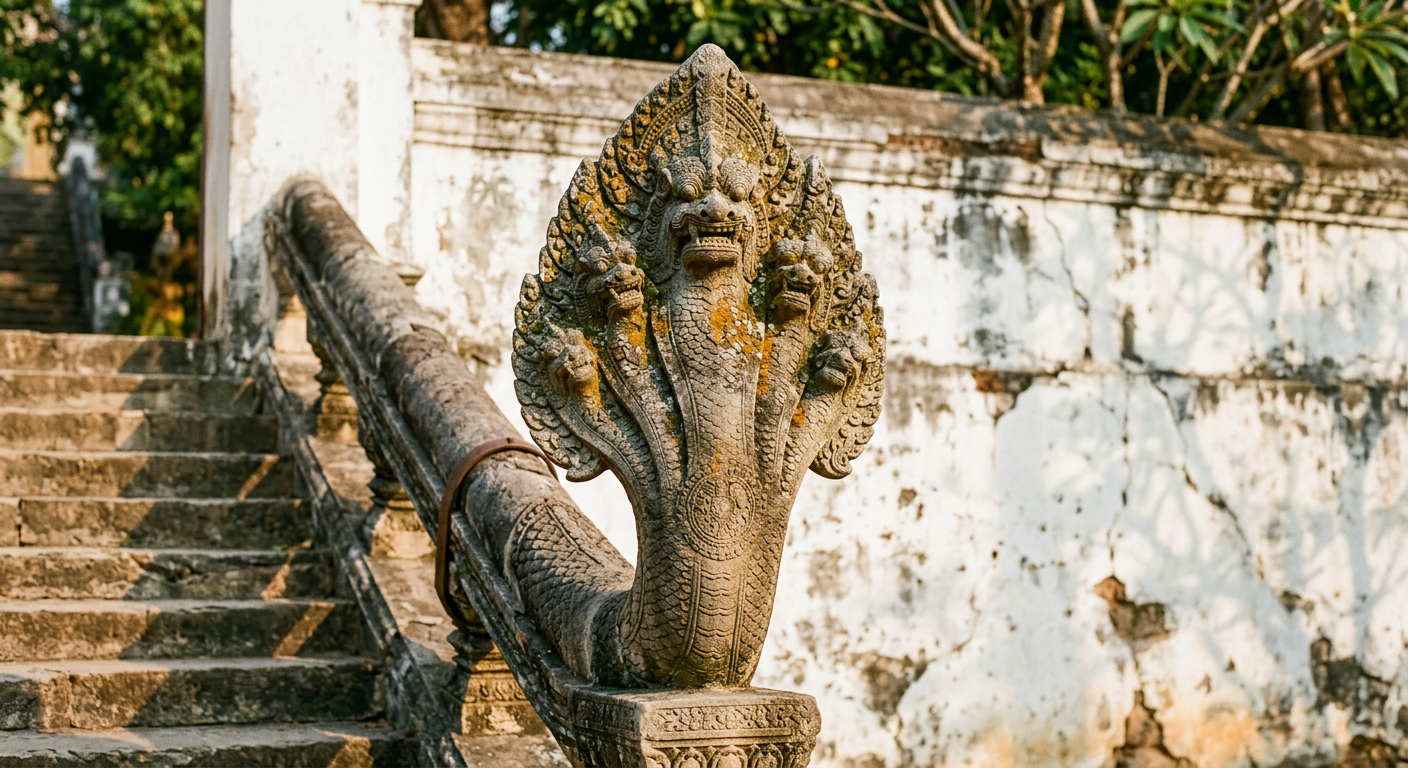
Naga (นาค) is the multi-headed serpent deity of Thai Buddhist iconography — a sacred protector motif used on temple staircase balustrades, roof finials, and boundary markers, deriving from Khmer pre-Buddhist serpent cults and absorbed into Thai Theravada visual vocabulary from the 12th century. Every major Thai temple features Naga balustrades on the staircases approaching the ubosot (ordination hall). The serpent’s body runs as the rail, its multi-headed head flares at the foot of the stair, and its tail terminates at the platform above. The composition is so standard that it functions as a structural expectation rather than a decorative choice.
The Naga is not ornamental. It is iconographic — a protector figure, the sheltering serpent that shielded the Buddha from rain during his meditation (Mucalinda episode), and a boundary guardian whose presence marks the transition between secular and sacred ground. For brand designers, this context makes Naga a restricted motif in practice: it works for heritage and cultural briefs, but using a Naga as a logo for a sports drink or fast fashion label reads as a category error.
Origin and historical context
Naga iconography entered Thai visual culture through Khmer transmission in the 11th and 12th century, building on older indigenous Southeast Asian serpent cults, and was fully codified as a Thai temple-architectural element by the Sukhothai and early Ayutthaya periods. The earliest surviving Thai Naga balustrades are on Khmer-influenced temples in the northeast (Phimai, Phanom Rung) where they retain distinctly Khmer proportion and ornament. By the Sukhothai period, Thai artisans had restyled the Naga into a more slender, flame-tipped form integrated with Lai Kanok vocabulary, and this Thai form was consolidated under Ayutthaya and Rattanakosin patronage.
The iconographic charge was reinforced by the Buddhist Mucalinda episode (the serpent king shielding the meditating Buddha) and by the Vessantara Jataka story cycle, both of which entered Thai mural convention during the Sukhothai period. The Naga in Thai temples is therefore both a guardian and a reference to these specific narrative episodes.
Regional variants are sharp. Lanna Naga (northern) carry Burmese influence and have more compressed, angular head forms. Isan (northeastern) Naga preserve Khmer proportions. Central Thai Naga (Bangkok and Ayutthaya) use the canonical Rattanakosin form.
Construction and geometry
Canonical Thai Naga balustrades use one, three, five, seven, or nine heads, with the head count carrying specific iconographic meaning, and follow fixed construction conventions for the head flare, body undulation, and tail termination. The construction rules:
- Head count rule. One head = minor temple or everyday register. Three heads = general temple balustrade. Five heads = significant royal or monastic commission. Seven heads = Mucalinda reference, reserved for temples enshrining important Buddha images. Nine heads = highest register, royal ordination halls and state temples.
- Head flare construction. Each head is rendered in profile with an open mouth showing the forked tongue and fangs, a flame-crested crown on the top of the skull, and a collar of stylised scales. Heads splay radially from the central neck like a peacock’s tail.
- Body proportion. The body width is approximately one-twentieth the total balustrade length. The body undulates in three to five major curves along the rail, each curve’s peak matching a structural column of the supporting architecture.
- Scale rendering. Scales along the body are drawn as overlapping lozenges, typically in seven rows of alternating colour (gold and red, gold and green, or gold and black lacquer).
- Tail termination. The tail terminates in a Kanok Pak Kra Ngae (split-tip flame curl), rising at a 45-degree angle above the platform at the stair top.
The Naga Sadung finial (roof-gable terminal) follows related but distinct rules, scaled for vertical orientation and integrated with the Cho Fa (sky-tassel) roof ornament.
Where it traditionally appears
Naga balustrades and finials appear on the staircases, roofs, and boundary markers of almost every Thai Buddhist temple, on royal and ceremonial barges, on manuscript chests, and on boundary stones (bai sema) marking consecrated ground. Named reference sites:
- Wat Phra Kaew, Bangkok — multiple Naga balustrades flank the central terrace staircases, finished in gold leaf and mirror mosaic
- Wat Phra That Phanom, Nakhon Phanom — Isan-style seven-headed Naga on the main stair, the reference for regional Naga iconography
- Wat Phra Singh, Chiang Mai — Lanna Naga on the ubosot stair with distinctive Burmese-influenced head flare
- Wat Arun, Bangkok — Naga ornament on the prang terraces, integrated with ceramic flower tile work
- Royal Barge Anantanagaraj (“Endless Naga King”) — the entire barge is carved as a single extended Naga figure, gilded and mirror-inlaid
- Wat Rong Khun, Chiang Rai — modernist Naga balustrade by artist Chalermchai Kositpipat, the most-photographed contemporary Naga in Thailand
- Phimai Historical Park, Nakhon Ratchasima — original Khmer-period Naga balustrades preserved in situ, reference for pre-Thai iconography
Cultural meaning and restrictions
Naga is a sacred protector figure, associated with Buddhism, water, fertility, and boundary guardianship — no legal restriction applies, but commercial use carries a cultural expectation of respectful register and is inappropriate for trivial or disrespectful brand contexts. Thai viewers do not react to a Naga in a hospitality brand identity; they react sharply to a Naga in a context that trivialises it.
Specific considerations:
- Religious weight. Naga is tied to the Buddha’s Mucalinda episode. Using the seven-headed form on a fast-food wrapper reads as disrespectful even though no law prohibits it.
- Regional sensitivities. In Isan (northeastern Thailand) and neighbouring Laos, the Naga has a distinct and stronger cult (the Mekong Naga fireballs tradition), and commercial use is scrutinised more closely there.
- Head count matters. A five- or seven-headed Naga signals sacred register. A single-headed Naga is more neutral and appropriate for general decoration.
- No Royal Household Bureau approval required (unlike Garuda).
- No weekday association.
Modern usage in graphic design
Contemporary Thai design uses Naga for heritage tourism branding, spa and wellness (drawing on the water-and-serenity association), craft beer packaging (the protective-guardian trope), and editorial illustration on Thai Buddhist themes. Recent examples:
- Tourism Authority of Thailand “Amazing Thailand” heritage campaign — Naga motif used as a cultural mark on the deep-heritage sub-campaigns, rendered in single-line geometric drawing
- Full Moon Brewworks (Phuket) craft beer line (2021) — single-headed Naga on the label of the flagship ale, in woodcut-style illustration
- Sala Rattanakosin Hotel, Bangkok — Naga sculptural element at the entrance, documented in the hotel’s visual identity system
- Sri Panwa Resort, Phuket — Spa line — simplified Naga head as the spa product mark
- Chalermchai Kositpipat print editions — fine-art Naga motifs in the artist’s distinctive blue-white style, widely collected
The pattern works when the brief has genuine cultural or spiritual weight. It fails when grafted onto brands whose positioning contradicts the Naga’s iconographic role.
Free download
The Naga vector pack on /patterns/downloads/ provides three- and five-headed balustrade forms, a single-head general-register version, and a Naga Sadung roof finial as CC BY 4.0 SVGs. Files are drawn from Rattanakosin canonical references with construction guides included. For the mythological-motif family in context, see Garuda and Kinnari. Generate custom colour variations using the Thai Pattern Maker.
Pattern generator: Naga
Set the tile size, stroke, color and rotation, then download the seamless Naga tile as SVG or PNG.
Showing Naga scale — tile 120px, stroke 2, rotation 0°.
Tiles are drawn in code from the motif's geometry — reconstructions, not tracings of one artefact. Exports are CC BY 4.0; credit ThaiGraph.com. For the full-size canvas, open the Thai Pattern Generator.
Information verified as of April 2026
Sources
- The Naga serpent motif in Thai temple decoration traces to pre-Buddhist Khmer iconography, adopted into Thai Theravada visual vocabulary during the 12th and 13th century.—Thai Royal Institute — Dictionary of Thai Ornament, 1999 edition (accessed Apr 10, 2026)
- Canonical Thai Naga balustrades use one, three, five, seven, or nine heads, with the head count carrying specific iconographic meaning tied to the subject of the adjacent temple.—No Na Paknam (1981). The Buddhist Boundary Markers of Thailand. Muang Boran Publishing House, Bangkok (accessed Apr 10, 2026)
- The Naga Sadung finial (the terminal curl at the top of a temple gable) is structurally required on Lanna and central Thai ubosot roofs and is documented in temple-building manuals from the early Rattanakosin period.—Fine Arts Department, Ministry of Culture, Thailand — Thai Temple Architecture handbook, 2012 (accessed Apr 10, 2026)
- The Naga Kae (emerald serpent) and Naga Song Nai (twin-bodied serpent) are the two principal sub-forms used on the flanking staircases of temple mondops across Thailand.—Chamni Reuangritt (2009). ตำราลายไทย (Thai Ornament Manual). Amarin Printing, Bangkok (accessed Apr 10, 2026)