Thai pattern · garuda
Garuda
ครุฑ

Information verified as of April 2026
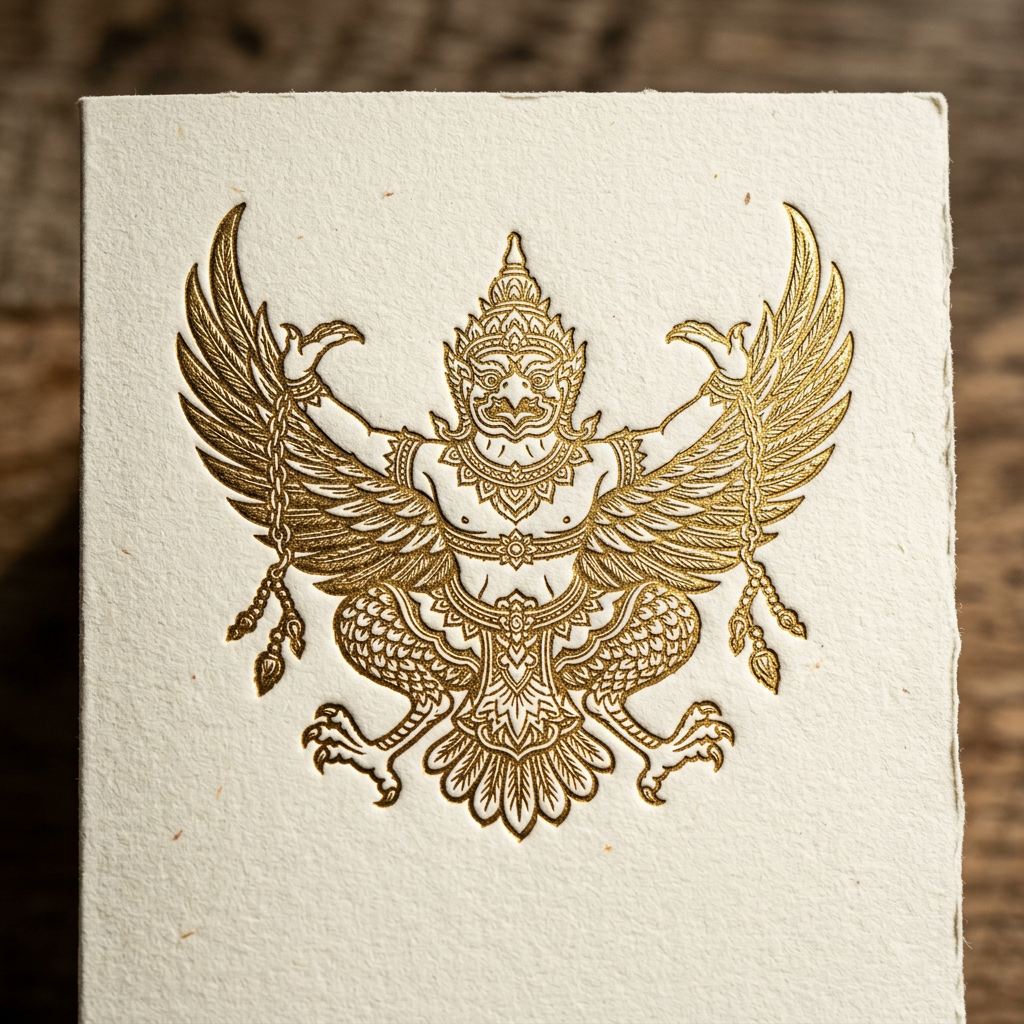

What the Garuda is
Garuda (ครุฑ) is the bird-king of Hindu-Buddhist mythology and the national emblem of the Kingdom of Thailand — a human-bodied, bird-headed figure with spread wings, used as the royal seal, the state seal, and the principal iconographic mark of the Thai monarchy and state. It appears on Thai passports, banknotes, government building facades, official documents, royal warrant marks held by about three hundred Thai companies, and the pediments of major royal temples. The figure is not ornamental — it is heraldic, and its use is regulated.
Garuda is the most restricted motif in this library. Every other pattern on ThaiGraph is available for commercial design work without legal clearance. The Garuda is not. Commercial use of the Garuda by a Thai company requires a formal Royal Warrant granted by the Royal Household Bureau, and the warrant must be periodically renewed. Non-Thai companies cannot receive a Royal Warrant. This page documents the motif for educational and editorial context; it should not be read as a green light for commercial use.
Origin and historical context
The Garuda entered Thai visual culture through Hindu-Brahmanic transmission during the pre-Sukhothai Khmer period, bringing with it the mythological role of Vishnu’s mount and the enemy of the Naga. For centuries the figure appeared in temple iconography alongside other Hindu-Buddhist motifs with no special political weight. The motif’s current status as the royal and state emblem of Thailand dates to a specific reform under King Vajiravudh (Rama VI) in 1911.
Rama VI, educated at Oxford and Sandhurst and deeply invested in modernising Thai heraldic conventions along European lines, commissioned the redesign of the royal seal. The resulting Khrut Pha (“Garuda bearing the Lord”) — a stylised Garuda with the monarch conceptually borne on its back — replaced the earlier state seal and was adopted as the emblem of the monarch, the government, and companies granted royal favour. Chula Chakrabongse’s Lords of Life documents the reform in detail.
Since 1911, the Thai Garuda has been legally distinct from the Hindu mythological Garuda that appears on temple pediments. The temple version remains a religious motif; the state version is a heraldic device with regulated use.
Construction and geometry
The Thai state Garuda is rendered frontally with spread wings, raised arms, bird’s head and hooked beak, human torso, bird’s lower legs with talons, and a specific posture distinct from other national Garuda emblems (Indonesia, India) in regional use. Construction rules:
- Overall silhouette. Roughly square bounding box; spread-wing width matches height.
- Head. Bird’s head with prominent curved beak, fierce eye, and a chada (Thai spired headdress) on the crown. Faces viewer directly.
- Torso. Human male torso, nude or draped, with a paha (loincloth wrap) rendered in Thai classical style.
- Arms. Raised in a dynamic posture, hands open or holding ritual objects (for temple versions) or empty (for the state seal version).
- Wings. Fully spread, rendered with three feather registers — primary flight feathers at the outer edge, coverts in the middle, smaller feathers at the shoulder. Feathers in overlapping lozenge pattern.
- Legs and tail. Bird’s lower legs with large talons, tail feathers flared outward.
- Proportional canon. Face-to-body ratio approximately 1:3; wingspan-to-body ratio approximately 3:1 across the full wing spread.
The state seal version uses a specific posture standardised by the Royal Household Bureau and reproduced from an official digital master file. Reproducing that specific master without authorisation is not permitted. Temple and ornamental Garuda, which predate the 1911 royal seal, follow older and more varied conventions and are not themselves restricted the way the state seal is.
Where it traditionally appears
The Thai state Garuda appears on Thai passports, banknotes, government building facades, royal warrants (the “By Appointment to His Majesty” mark held by about three hundred Thai companies), royal ceremonial objects, and the pediments of first-tier royal temples. Named reference appearances:
- Thai passport cover — gold Garuda centered on maroon, the national emblem in its official form
- Thai baht banknotes — Garuda on the reverse of all denominations
- Government House, Bangkok — Garuda on the main facade
- Royal Thai Embassy buildings worldwide — Garuda on signage and official seals
- Royal warrant marks — held by companies including Singha Corporation, Boon Rawd Brewery, Thai Airways, Siam Commercial Bank, and approximately 300 others, documented in the Royal Household Bureau register
- Wat Phra Kaew ubosot pediment — the temple Garuda, pre-modern in style, distinct from the state seal
- Thai Airways livery and tail fin — a highly stylised Garuda-derived wordmark, used under royal warrant
- Royal Thai Army and Navy flags — Garuda variants on certain royal and state flags
Cultural meaning and restrictions
Garuda is the most legally and culturally restricted motif in Thai visual culture — commercial use requires a Royal Warrant (By Appointment to His Majesty the King) granted by the Royal Household Bureau, and use without the warrant exposes a business to legal and reputational consequences in Thailand. The restriction is the practical reason a designer working on a Thai brief should not propose Garuda without first clearing it.
What you cannot do:
- Use the state-seal Garuda on commercial packaging or branding without a Royal Warrant.
- Use any Garuda-adjacent mark that could be confused with the royal seal.
- Use Garuda in disrespectful or satirical contexts. Thailand’s lese-majeste law (Section 112 of the Thai Criminal Code) covers insult to royal symbols, and Garuda is a royal symbol.
- Register a trademark that includes a Garuda figure. The Thai Department of Intellectual Property rejects applications that include royal symbols without warrant.
What is available:
- Temple pediment Garuda in editorial and educational contexts — the older temple tradition predates the 1911 royal seal and is available for editorial, academic, and cultural use.
- Himmaphan-style Garuda in heritage and cultural work (e.g., traditional dance performance programmes) — with cultural-context awareness.
- Reference illustrations in historical and educational material such as the content on this page.
No weekday association applies. The restriction is legal and political, not ceremonial.
Modern usage in graphic design
Commercial use of Garuda in Thai graphic design is overwhelmingly confined to the approximately three hundred companies that hold Royal Warrants, and new designers should assume the motif is off-limits unless a brief explicitly comes with existing warrant credentials. Representative warrant-holder use:
- Singha / Boon Rawd Brewery — the Singha mark itself is a Garuda-adjacent mythological creature; the company holds long-standing Royal Warrant, visible on the label
- Siam Commercial Bank — Garuda appears on formal corporate material and branch signage
- Thai Airways — stylised Garuda-derived identity, used under warrant; any new Thai airline would not receive equivalent clearance
- Royal Project Foundation — Garuda on product packaging, authorised under royal project status
Editorial and cultural use (by publications, museums, academic institutions) is broader and generally unproblematic. The Siam Society, the Fine Arts Department’s own publications, and museum catalogues regularly reproduce Garuda imagery in historical context.
For a designer without warrant, practical options for Thai briefs calling for a “majestic bird” motif include Hongsa (swan, unrestricted), generic Himmaphan bird figures, or Kinnari (half-human, half-bird, unrestricted — see /patterns/kinnari/).
Free download
A reference Garuda vector is available on /patterns/downloads/ for educational and editorial use only, under CC BY 4.0 with an added non-commercial notice specific to this file. The file is a temple-tradition pediment Garuda drawn from public-domain references (not the Royal Household Bureau state seal), intended for academic publications, museum materials, and editorial illustration. For commercial work, consult the Bureau of the Royal Household warrant procedures and review the unrestricted Kinnari motif as a heritage alternative.
Pattern generator
The generator has no Garuda tile yet, so it opens on the nearest motif it can draw, Lai Kanok. Set the tile size, stroke, color and rotation, then download the result as SVG or PNG.
Showing Lai Kanok — tile 120px, stroke 2, rotation 0°.
Tiles are drawn in code from the motif's geometry — reconstructions, not tracings of one artefact. Exports are CC BY 4.0; credit ThaiGraph.com. For the full-size canvas, open the Thai Pattern Generator.
Information verified as of April 2026
Sources
- Garuda is the national emblem of the Kingdom of Thailand and the heraldic device of the monarch, used on official government seals, passports, currency, and royal warrants.—Office of the Royal Household, Bureau of the Royal Household — Royal Emblem and Regalia Handbook, 2018 (accessed Apr 10, 2026)
- Commercial use of the Garuda by a business requires formal Royal Warrant (By Appointment to His Majesty the King), granted by the Royal Household Bureau and subject to renewal.—Bureau of the Royal Household — Royal Warrant Application procedures, Royal Office (royaloffice.th) (accessed Apr 10, 2026)
- The contemporary Thai Garuda (Khrut Pha, 'Garuda bearing the Lord') derives from the royal seal designed in 1911 under King Vajiravudh (Rama VI), replacing an earlier state seal.—Chula Chakrabongse (1960). Lords of Life: A History of the Kings of Thailand. Alvin Redman — chapter on Rama VI heraldic reforms (accessed Apr 10, 2026)
- The Garuda figure in Thai iconography is rendered with human torso, bird's head and beak, wings spread, raised arms, and talons, distinct from the Indonesian (Garuda Pancasila) and Indian Garuda conventions.—Piriya Krairiksh (2012). The Roots of Thai Art. River Books, Bangkok (accessed Apr 10, 2026)