Thai pattern · dok-mai
Lai Dok Mai
ลายดอกไม้

Information verified as of April 2026

What the Lai Dok Mai is
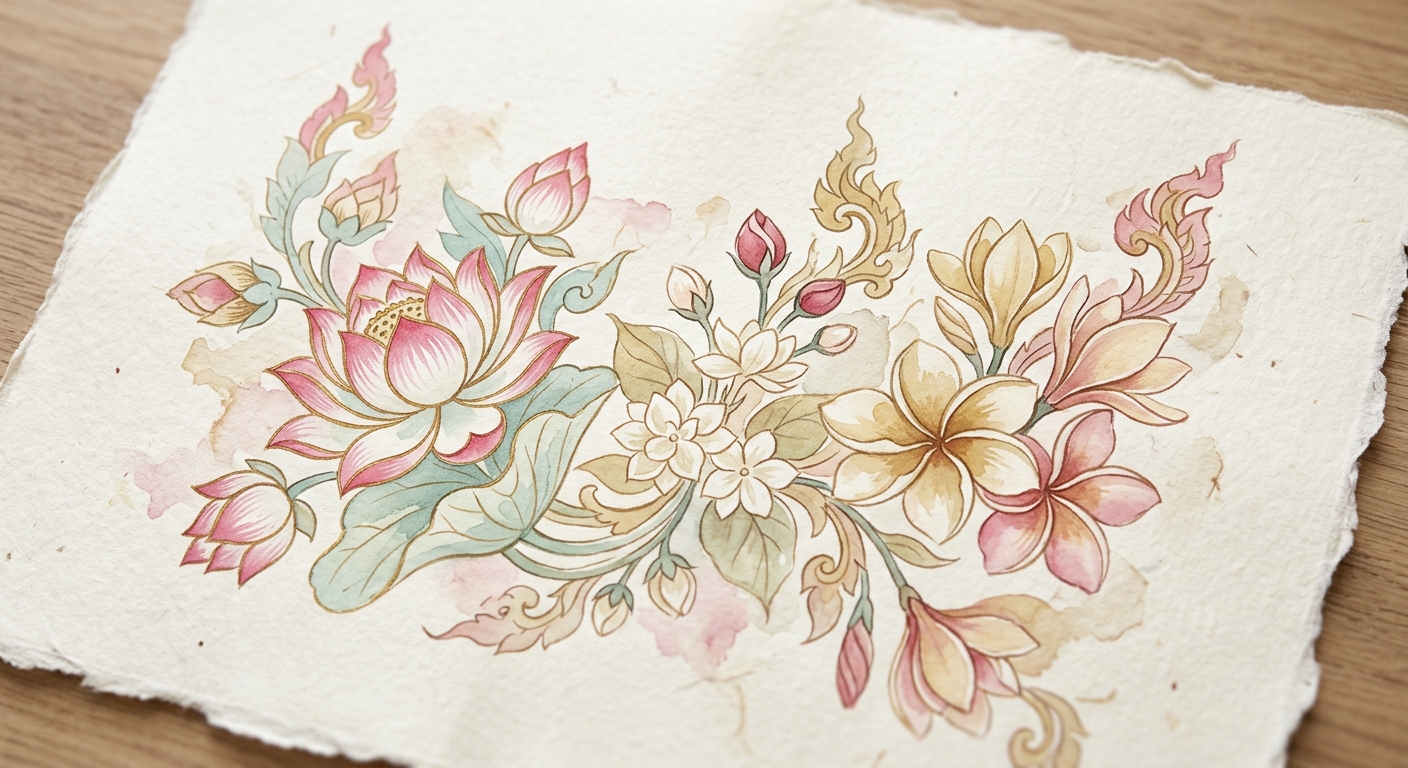
Lai Dok Mai (ลายดอกไม้) is the Thai floral motif family — stylised renderings of lotus, jasmine, champa, bougainvillea, frangipani, and a dozen other flowers, each with specific iconographic weight and compositional role within the broader Lai Thai vocabulary. Every flower is named, every name carries meaning, and the meanings govern where the flower may be used. A jasmine garland on a Mother’s Day campaign reads correctly. The same jasmine garland on a funeral invitation would read as an error, because jasmine belongs to celebration rather than remembrance.
The Fine Arts Department recognises approximately fifteen canonical flowers in the Lai Dok Mai family, with lotus at the top of the hierarchy (Buddhist association) and the secondary tier occupied by the flowers with ceremonial or royal roles. The remainder are everyday ornament.
For brand designers, Lai Dok Mai is the family most often drawn from for spa, hospitality, wellness, and consumer product briefs — the iconography is soft, the rules are manageable, and the outputs translate naturally to modern packaging and editorial.
Origin and historical context
The individual flowers of Lai Dok Mai were documented across the Sukhothai, Ayutthaya, Lanna, and Rattanakosin periods, with lotus iconography the oldest and most continuously documented, traceable to pre-Sukhothai Dvaravati sculpture (7th–11th century). Lotus arrived with Buddhism and Brahmanism from India through Sri Lankan and Khmer transmission, and its canonical three-stage rendering (bud, half-bloom, full-bloom) corresponds to early-medieval Buddhist iconographic conventions shared across Theravada Southeast Asia.
Jasmine, champa, and bougainvillea entered the ornamental canon later, through textile and lacquer work of the Ayutthaya period, when Thai court design absorbed Persian and Chinese floral conventions alongside the existing Indic lotus. The Thai restyling kept the naturalistic reading (flowers remain recognisable as themselves) while imposing the same geometric discipline applied to Kanok and Pra Jum Yam — each flower has a fixed proportion, a fixed number of petals, and a fixed palette.
The Queen Sirikit Museum of Textiles holds the most comprehensive documentation of floral motifs on court dress, from 17th-century Ayutthaya fragments through modern royal textiles.
Construction and geometry
Each flower in the Lai Dok Mai family has its own construction rule, but all are built on a radial grid with petal count fixed per flower and petal proportion set to a canonical ratio with the central disc. The principal flowers and their rules:
| Flower | Thai name | Petal count | Iconographic weight |
|---|---|---|---|
| Lotus | ดอกบัว Dok Bua | 8, 12, or 16 | Buddhist purity, spiritual elevation |
| Jasmine | ดอกมะลิ Dok Mali | 5 or 6 | Mother’s Day, maternal love, purity |
| Champa / Frangipani | ดอกจำปา Dok Champa | 5 | Remembrance, funerary ritual |
| Bougainvillea | ดอกเฟื่องฟ้า Dok Fueang Fa | 3 (bracts, triangular) | Hospitality, warmth |
| Bua Luang (Royal Lotus) | ดอกบัวหลวง | 8 with concentric ring | Royal and monastic register |
| Dok Pikun | ดอกพิกุล | 6 small petals | Small-scale fill, textile repeat |
| Dok Rak (Ixora) | ดอกรัก | 4 | Love, wedding |
| Dok Kratin | ดอกกระถิน | Many small | Everyday decoration |
Lotus construction illustrates the family’s geometry. The eight-petal full-bloom lotus uses the same radial grid as the eight-petal Pra Jum Yam but with more naturalistic petal curves — the petals taper to a soft point and have an inner fold rendered as a secondary lobe. Half-bloom lotus shows only three or four visible petals from a side-profile angle. Closed-bud lotus is rendered as a tight vertical almond with the petal folds marked as incised lines.
Jasmine construction is simpler — five small round petals arranged around a yellow central disc, typically clustered into sprigs of three to five flowers joined by leaf stems.
Where it traditionally appears
Lai Dok Mai dominates Thai ceremonial textiles, lacquer panels, court dress, temple mural borders, and contemporary hospitality and wedding decor. Named examples and traditions:
- Phra Maha Phichai Mongkut (Great Crown of Victory) — lotus motifs worked into the gold tier bands
- Queen Sirikit Museum of Textiles “Dok Lai” Collection — Ayutthaya-period silk with woven jasmine and bougainvillea patterns
- Wat Phra Kaew mural borders — lotus and champa alternating as border fill below the figurative Ramakien cycle
- Thai wedding pan kan (engagement tray) traditions — fresh jasmine garlands arranged as Dok Mali patterns, echoing the ornamental motif
- Chao Phraya dining ware, late Rattanakosin — porcelain with hand-painted Dok Pikun repeat patterns
- Modern Mother’s Day civic decoration — jasmine garlands and Dok Mali motifs dominate public display during August observances
- Thai funeral wreaths (Phuang Malai) — champa is the expected flower, and its motif appears on funerary ceremonial printing
Regional variants matter. Lanna textiles use Dok Pikun and Dok Kratin more heavily. Southern Thai ornament draws on bougainvillea and frangipani. Central Thai court work privileges lotus and jasmine.
Cultural meaning and restrictions
Lai Dok Mai flowers carry specific ceremonial associations that designers must respect — jasmine belongs to Mother’s Day and celebratory contexts, champa belongs to remembrance and funerals, lotus belongs to Buddhist register, bougainvillea reads as hospitable and unrestricted. There are no legal restrictions on any flower, but mismatching the flower to the occasion is the most common error on Thai-themed brand work produced outside Thailand.
Practical rules:
- Do not use champa on celebratory work (weddings, openings, children’s products). It reads as funerary to Thai audiences of all ages.
- Use jasmine for maternal, floral, and celebratory briefs. It is universally positive.
- Use lotus with awareness of its Buddhist weight. For a spa or wellness brand it reads naturally. For a bar or nightclub it reads as tonally wrong.
- Bougainvillea and frangipani are fully permissive and are the safest choices for ambiguous hospitality briefs.
- Bua Luang (royal lotus) pairs with the royal register — same etiquette considerations as sixteen-petal Pra Jum Yam.
No weekday associations apply individually. Jasmine intensifies on 12 August; champa intensifies at funerals and Phi Ta Khon festival.
Modern usage in graphic design
Contemporary Thai spa, wellness, and hospitality branding draws most heavily on Lai Dok Mai, typically through a single flower rendered in a simplified line-drawing style on packaging, stationery, and identity systems. Recent work:
- Karmakamet flagship incense packaging (2022) — single lotus bloom as the product line identifier, line-drawn in white on indigo
- THANN rice-bran skincare line — jasmine sprig motif on the bottle labels, printed in a single-colour floral repeat
- Oriental Princess cosmetics — Dok Pikun repeat pattern on the box interiors for the premium line
- Mae Fah Luang Foundation packaging — champa motif on the funeral-rites-adjacent memorial product, appropriately context-matched
- Siam Kempinski Bangkok wedding stationery — Dok Mali (jasmine) and Dok Rak (ixora) motifs on invitation suites, printed in gold foil
Pattern works in modern applications because a single botanical motif reads cleanly against generous negative space. It fails when designers combine multiple flowers from different ceremonial registers — a jasmine-and-champa wedding invitation, for instance, reads as confused to Thai guests.
Free download
The Lai Dok Mai vector pack on /patterns/downloads/ provides eight flowers as CC BY 4.0 SVGs — lotus (all three stages), jasmine sprig, champa, bougainvillea, Dok Pikun, Dok Rak, and Dok Kratin. Files include construction grids and seamless textile-repeat variants for lotus and jasmine. Use the Thai Pattern Maker to build custom combinations, and see the Pra Jum Yam page for the radial star-flower that sits adjacent to the floral family in Lai Thai vocabulary.
Pattern generator
The generator has no Lai Dok Mai tile yet, so it opens on the nearest motif it can draw, Pra Jum Yam. Set the tile size, stroke, color and rotation, then download the result as SVG or PNG.
Showing Pra Jum Yam — tile 120px, stroke 2, rotation 0°.
Tiles are drawn in code from the motif's geometry — reconstructions, not tracings of one artefact. Exports are CC BY 4.0; credit ThaiGraph.com. For the full-size canvas, open the Thai Pattern Generator.
Information verified as of April 2026
Sources
- Thai floral motifs are grouped into approximately fifteen named flowers with iconographic roles assigned by Buddhist, Brahmanic, and royal association.—Fine Arts Department, Ministry of Culture, Thailand — Dictionary of Thai Ornament, 1999 edition (accessed Apr 10, 2026)
- Jasmine (Dok Mali) is the official symbol of Thai Mother's Day (12 August, the Queen Mother's birthday) and its decorative use intensifies during the observance.—Thai Ministry of Culture — National Observances handbook, 2019 revision (accessed Apr 10, 2026)
- The lotus motif in Thai ornament is constructed in three canonical stages representing the closed bud, half-open bloom, and full-bloom forms, each with distinct iconographic weight.—No Na Paknam (1981). The Buddhist Boundary Markers of Thailand. Muang Boran Publishing House, Bangkok (accessed Apr 10, 2026)
- Champa (Dok Champa) is associated with remembrance and funerary ritual in Thai tradition, which constrains its use on celebratory brand work.—Chamni Reuangritt (2009). ตำราลายไทย (Thai Ornament Manual). Amarin Printing, Bangkok (accessed Apr 10, 2026)