Thai pattern · pra-jum-yam
Pra Jum Yam
ประจำยาม

Information verified as of April 2026
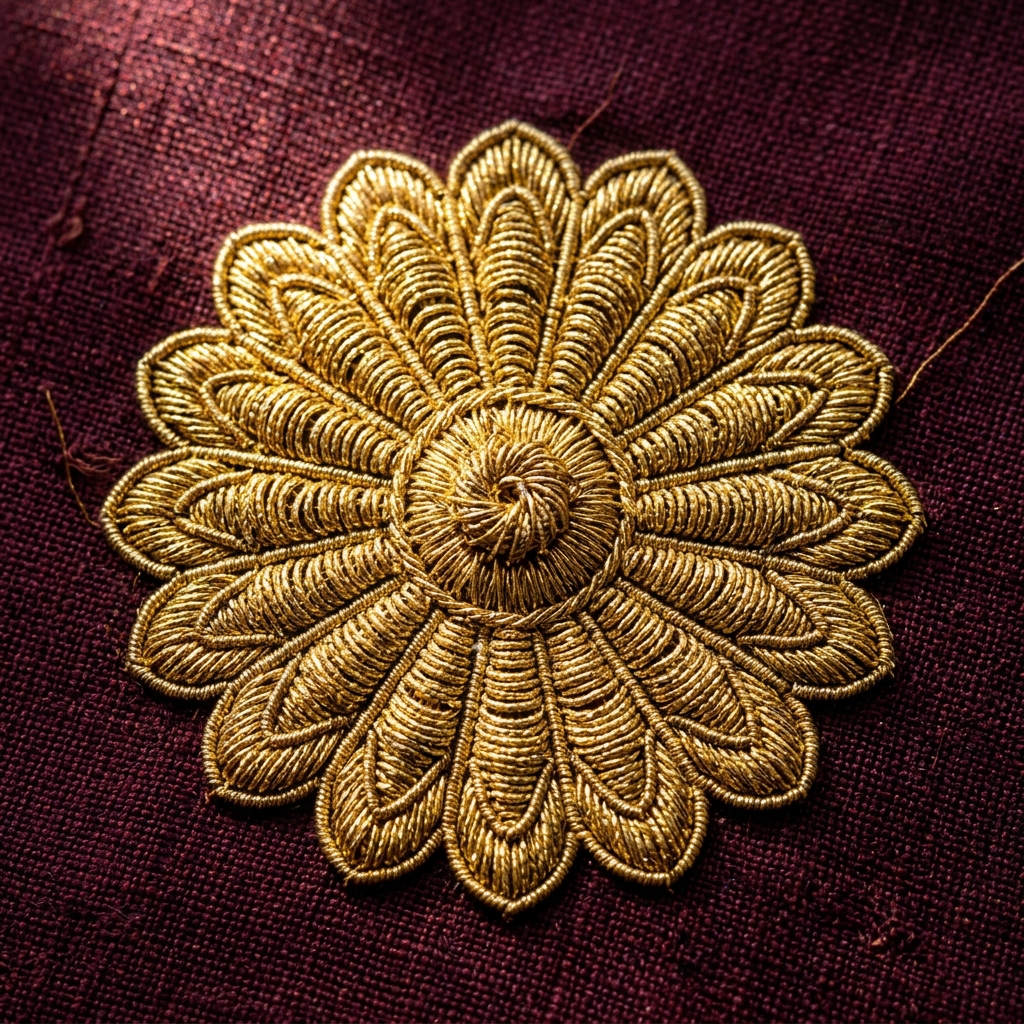

What the Pra Jum Yam is
Pra Jum Yam (ประจำยาม) is the radial star-flower motif of Thai ornamental tradition — a symmetrical rosette with eight or sixteen petals, built on a circular grid, and used as the central or corner seal in elite and ceremonial compositions. The name is usually translated “at-every-watch” or “perennial,” reflecting the motif’s meaning as the cosmic order that holds across all times. In practical terms, it functions as the Thai equivalent of a hallmark — the stamp that marks a composition as belonging to the royal, religious, or heraldic register.
The motif is immediately recognisable as a rosette, but Thai artisans treat it as a structural centre rather than a floral decoration. A Pra Jum Yam does not sit in a composition; the composition is built around it.
For brand designers, this is the motif most often requested on heritage luxury briefs — jewelry, hospitality, royal warrant-adjacent product lines — because its geometry reads as elevated without requiring the legal clearance that Garuda use demands.
Origin and historical context
Pra Jum Yam derives from Hindu padma (lotus) radial iconography, transmitted into Thai visual culture through Khmer temple decoration during the Angkorian period and codified into Thai ornament during the Sukhothai and Ayutthaya periods from the 13th to 15th century. Piriya Krairiksh’s Roots of Thai Art traces the eight-petal form to the Brahmanic padma mandala used in Khmer temples at Angkor Wat and Banteay Srei, adopted by Thai court and temple craftsmen as the symbolic centre of cosmic ordering.
The Thai restyling is specific. Where the Khmer padma is often naturalistic (recognisably a lotus bloom), Thai Pra Jum Yam is geometric — the petals are stylised into almond-shaped lobes on an exact radial grid, and the central disc is proportioned to a fixed ratio with the petal length. The motif was fully canonical by the mid-Ayutthaya period and is the dominant ornament on royal regalia that survive from the 17th century forward.
The Royal Regalia catalogue (Office of the Royal Household, 2016) documents Pra Jum Yam on the Great Crown of Victory, the Royal Nine-Tiered Umbrella, ceremonial swords, and the coronation Sacred Water urns.
Construction and geometry
The canonical forms are the eight-petal (Prajam Yam Paed Klip) and sixteen-petal (Prajam Yam Sipho Klip) rosettes, constructed on a radial grid with 45-degree and 22.5-degree divisions respectively. The Silpakorn handbook sets out the construction as:
- Draw a circle defining the outer bound.
- Draw a second concentric circle at approximately 35% of the outer radius — this is the central disc.
- Divide the outer circle into eight or sixteen equal sectors (45 or 22.5 degrees).
- On each sector axis, draw the petal as an almond (vesica piscis) shape reaching from the central disc to the outer bound.
- Add a secondary ring of smaller petals rotated 22.5 degrees offset from the primary petals (optional, produces the “double rosette” form).
- Fill the central disc with a smaller Pra Jum Yam (recursive), a Kanok unit, or a Dharmachakra wheel depending on register.
Proportions are fixed. The petal length is three times the central disc radius in the canonical form. The petal width at its widest point is one-fifth of its length. Double-ring Pra Jum Yam uses a 3:2 size ratio between the outer and inner rings of petals.
Sixteen-petal forms are reserved for the highest register (royal crowns, the central ceiling medallion of a royal hall). Eight-petal forms are the general-purpose version used in temple ceilings, cabinet panels, and textiles.
Where it traditionally appears
Pra Jum Yam dominates Thai royal regalia, royal ceremonial architecture, and elite-register lacquer and textile work. Named examples:
- Phra Maha Phichai Mongkut (Great Crown of Victory) — the principal element of the Thai regalia is constructed around a central Pra Jum Yam with stacked sixteen-petal tiers, documented in the 2016 Royal Household catalogue
- Royal Nine-Tiered Umbrella (Nopphapadon Maha Svetachat) — each tier features Pra Jum Yam medallions in gold embroidery on white silk
- Chakri Maha Prasat Throne Hall, Grand Palace, Bangkok — the ceiling coffers are Pra Jum Yam panels in gold leaf on indigo
- Wat Phra Kaew ubosot ceiling — central Pra Jum Yam medallion directly above the Emerald Buddha
- Royal Barge Suphannahong interior — Pra Jum Yam seals on the canopy textile
- Manuscript cabinet, Rama III period, National Museum Bangkok — mother-of-pearl Pra Jum Yam corner seals on a black lacquer ground
- Court textile “sabai” sashes — Pra Jum Yam embroidered in gold thread on silk, worn as rank markers
Temple use outside the royal register is common but always at the central ceiling position or at the corners of panel borders, never as scattered decoration.
Cultural meaning and restrictions
Pra Jum Yam symbolises cosmic order, royal legitimacy, and Buddhist Dharma, and while no formal legal restriction applies to its use, the sixteen-petal form is conventionally reserved for royal and ceremonial contexts. The eight-petal form is fully available for commercial and secular design.
The convention is strictly observed in Thailand. A brand using a sixteen-petal Pra Jum Yam as a logo will read to Thai audiences as royal-warrant-adjacent and, if the brand has no royal connection, as presumptuous. The eight-petal form carries no such association and is widely used on heritage luxury packaging, hospitality identity, and editorial design.
No weekday association applies. No Royal Household Bureau approval is legally required (unlike Garuda), but commercial use of the sixteen-petal form alongside royal iconography may draw scrutiny under Thailand’s stringent protection of royal symbols. Stay with the eight-petal version for commercial work.
The central disc of the motif is traditionally filled with another small motif. Leaving it empty reads as unfinished to Thai viewers.
Modern usage in graphic design
Contemporary Thai luxury and heritage brands use the eight-petal Pra Jum Yam as a hallmark or seal element, most often at small scale on packaging and stationery as a quality mark. Representative recent work:
- Jim Thompson silk brand (2021 refresh) — Pra Jum Yam eight-petal seal used as the care-label mark on every garment, rendered in single-colour embroidery
- The Peninsula Bangkok hotel — Pra Jum Yam medallion on menu covers and room-key envelopes, embossed in copper on ivory stock
- Royal Orchid Sheraton stationery — corner ornament on writing paper, printed in gold foil
- THANN wellness packaging — Pra Jum Yam as the product-line identifier on the jar lid, scaled small and centred
- Chiang Mai Design Week 2023 identity — abstract Pra Jum Yam used as the festival mark, reduced to a single-line geometric drawing
The pattern fails when designers scale it up as a decorative pattern fill. It is a seal, not a wallpaper.
Free download
The Pra Jum Yam vector pack on /patterns/downloads/ provides both the eight-petal (Paed Klip) and the reserved-use sixteen-petal (Sipho Klip) forms as CC BY 4.0 SVGs. Files include the radial construction grid as a hidden layer, and a double-ring variant is available separately. Use the Thai Pattern Maker to colour the petals from a Thaitone palette. For related radial and floral motifs, see the Lai Dok Mai page and the patterns index.
Pattern generator: Pra Jum Yam
Set the tile size, stroke, color and rotation, then download the seamless Pra Jum Yam tile as SVG or PNG.
Showing Pra Jum Yam — tile 120px, stroke 2, rotation 0°.
Tiles are drawn in code from the motif's geometry — reconstructions, not tracings of one artefact. Exports are CC BY 4.0; credit ThaiGraph.com. For the full-size canvas, open the Thai Pattern Generator.
Information verified as of April 2026
Sources
- Pra Jum Yam is the Thai adaptation of Hindu padma (lotus) radial iconography, transmitted through Khmer temple decoration and codified into Thai ornament during the Sukhothai and Ayutthaya periods.—Piriya Krairiksh (2012). The Roots of Thai Art. River Books, Bangkok (accessed Apr 10, 2026)
- The canonical forms are the eight-petal (Prajam Yam Paed Klip) and sixteen-petal (Prajam Yam Sipho Klip) rosettes, constructed on a radial grid with 45-degree and 22.5-degree divisions.—Faculty of Decorative Arts, Silpakorn University — Thai Ornamental Drawing course handbook, 2020 edition (accessed Apr 10, 2026)
- The motif dominates royal regalia including the Great Crown of Victory (Phra Maha Phichai Mongkut) and the Royal Nine-Tiered Umbrella, and is used on ceremonial lacquer cabinets and manuscript covers.—Office of the Royal Household, Bureau of the Royal Household — Royal Regalia illustrated catalogue, 2016 (accessed Apr 10, 2026)
- Pra Jum Yam compositions were used on the ceiling coffers of Wat Phra Kaew and the Grand Palace Chakri throne hall as markers of royal and cosmic hierarchy.—Fine Arts Department, Ministry of Culture — Grand Palace architectural survey, 2008 (accessed Apr 10, 2026)