Thai pattern · thai
Lai Thai
ลายไทย

Information verified as of April 2026

What the Lai Thai is
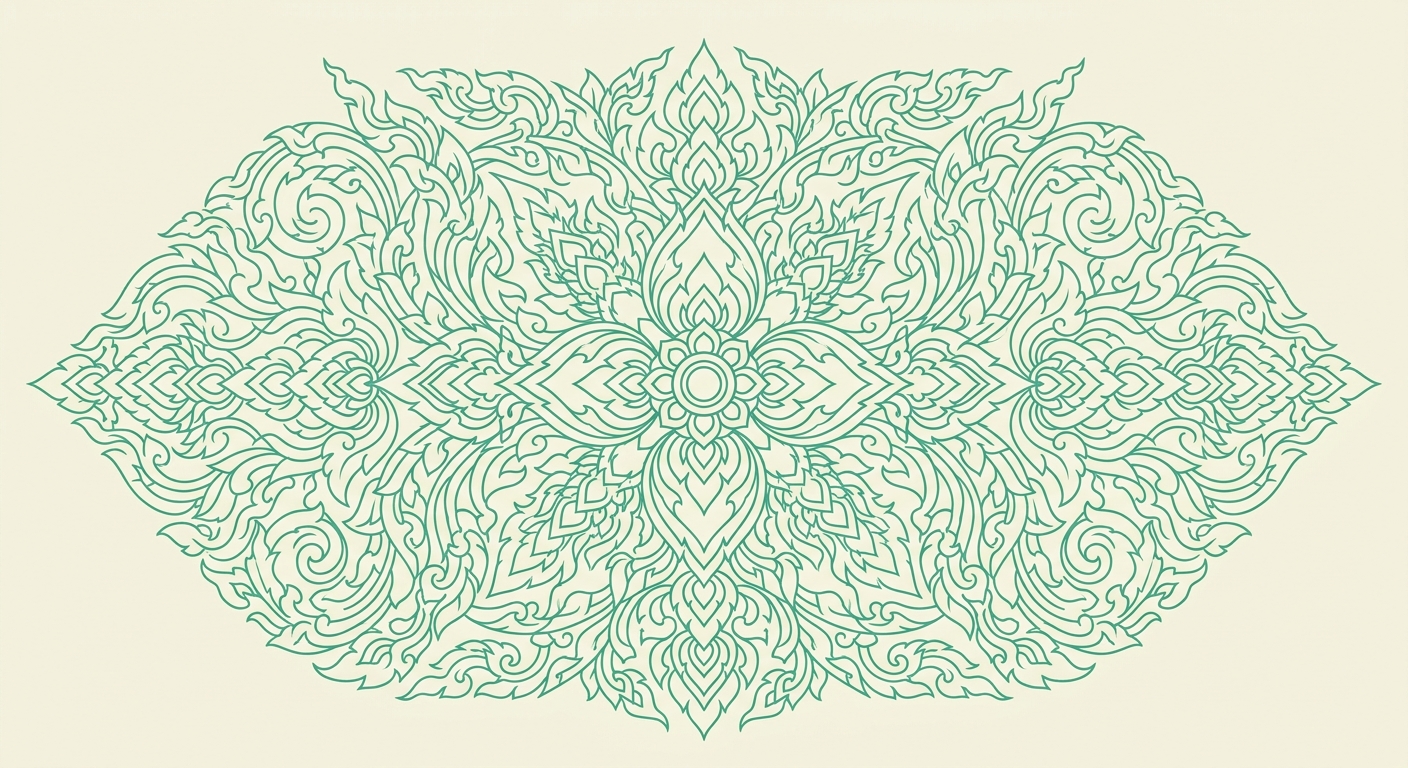
Lai Thai (ลายไทย) is the umbrella term for the entire traditional Thai ornamental vocabulary — a closed system of roughly twelve motif families and two hundred named sub-variants that together make up the grammar of Thai decorative art. When a Thai client asks for “Lai Thai,” they are almost never naming a specific motif. They are asking for a composition in the traditional idiom: symmetrical, radial-organised, register-stacked, and built from named elements rather than invented forms.
The Fine Arts Department’s Dictionary of Thai Ornament is the authoritative reference, and it treats Lai Thai as finite and nameable. Every element has a name. Every name has construction rules. A designer who invents a motif and labels it “Lai Thai” is working outside the tradition even if the result looks superficially Thai.
For graphic designers, understanding Lai Thai as a system rather than a style is the shift that separates culturally literate work from pastiche. This page is the map. Each named motif has its own library page with construction rules and downloads.
Origin and historical context
The term “Lai Thai” first appears in Ayutthaya-period palace inventories from the 17th century, where it functioned as a category label distinguishing Siamese work from imported Chinese and Persian ornament that circulated through the port of Ayutthaya. Prince Damrong Rajanubhab’s 1931 History of Buddhist Monuments in Siam (the foundational text of modern Thai art history) traces the term’s early use in royal storehouse records.
The individual motifs predate the umbrella term by centuries. Kanok appears on Sukhothai-period stucco (13th–14th century). Dok Mai (floral) and Mek Lai (cloud) motifs circulate earlier still, absorbed from Khmer and Chinese sources and restyled into Thai forms. What the Ayutthaya-period term did was codify a vocabulary that had been accumulating for several hundred years, giving it a collective identity under royal patronage.
The Rattanakosin period (Bangkok, 1782–present) is when the full vocabulary was consolidated into teaching manuals. The early 20th-century reforms under Rama VI and Rama VII established Silpakorn’s curriculum, and Silpakorn’s sequence of named motifs is the reference for professional practice today.
Construction and geometry
Lai Thai composition follows three organising principles: bilateral or radial symmetry, register stacking, and the nested-motif rule (larger motifs contain smaller ones of the same family). The grammar is best understood by mapping the twelve principal families and their typical compositional role.
| Family | Thai term | Compositional role |
|---|---|---|
| Kanok | กนก | Primary flame unit, builds most borders and pediments |
| Prajam Yam | ประจำยาม | Radial star-flower, used as centres and seals |
| Kranok Prajam Yam | กนกประจำยาม | Hybrid radial Kanok, corners and medallions |
| Dok Mai | ดอกไม้ | Floral accents, textile and lacquer fields |
| Mek Lai | เมฆลาย | Cloud bands, ceiling and robe borders |
| Lai Kan Kot | ลายก้านขด | Scrolling tendril, connects major motifs |
| Kan Yaeng | ก้านแย่ง | Branching vine, secondary fill |
| Lai Thep | ลายเทพ | Deity figure, iconographic register |
| Naga | นาค | Serpent, balustrade and finial |
| Kinnari | กินรี | Celestial figure, mural register |
| Garuda | ครุฑ | Bird king, royal and state register |
| Lai Krob | ลายกรอบ | Border frame, edges and panels |
Composition builds outward from a Prajam Yam centre, spirals through Kanok arrays, and resolves at Lai Krob frames. Every motif has a fixed scale relationship to its neighbours — Kanok is never the largest element in a composition that includes Lai Thep or Garuda, because the iconographic hierarchy outranks the geometric one.
Where it traditionally appears
Full Lai Thai compositions dominate Thai religious and royal material culture — temple murals, manuscript cabinets, lacquer panels, mother-of-pearl inlay, ceremonial textiles, and stucco reliefs across six hundred years of Thai craft. Representative reference sites:
- Wat Phra Kaew (Temple of the Emerald Buddha), Bangkok — the full murals of the Ramakien cycle are Lai Thai compositions at architectural scale, with every register occupied
- Wat Phra Si Sanphet, Ayutthaya — surviving stucco fragments showing the Ayutthaya-period vocabulary
- Wat Phra That Lampang Luang, Lampang — the finest preserved Lanna-style Lai Thai murals, 15th–16th century
- National Museum Bangkok, Manuscript Cabinet Collection — seventeenth- through nineteenth-century lacquer and mother-of-pearl cabinets demonstrate the full vocabulary applied to portable objects
- Royal Thai Textile Collection, Queen Sirikit Museum — ceremonial court dress showing textile-register Lai Thai
Regional variants matter. Lanna (northern) Lai Thai compresses the Kanok curls and absorbs Burmese register conventions. Southern Lai Thai (Nakhon Si Thammarat) preserves Srivijaya-adjacent floral elaboration. Isan (northeastern) work shows Lao and Khmer crossover.
Cultural meaning and restrictions
Lai Thai as a vocabulary is permissive for secular and commercial use — no umbrella restriction applies — but individual motifs within it carry their own rules. Garuda requires Royal Household Bureau approval for commercial deployment. Lai Thep (deity figures) and Yantra (sacred geometry) are religious material and should not be used casually. The remaining motifs (Kanok, Prajam Yam, Dok Mai, Mek Lai, Lai Kan Kot, border families) are fully available.
The cultural etiquette, which is enforced socially rather than legally, is that Lai Thai compositions should maintain hierarchy. Mixing the royal register with the everyday register reads as disrespectful. A brand using Garuda alongside cartoon floral patterns will be flagged by older Thai audiences as culturally illiterate even if no law has been broken.
No weekday association applies to the umbrella term. Specific motifs have ceremonial associations (Lotus with Buddhist observance, Jasmine with Mother’s Day, 12 August) but Lai Thai itself is unrestricted.
Modern usage in graphic design
Contemporary Thai brand and editorial work uses Lai Thai as a grammar rather than a stylistic overlay — the strongest examples pick one or two families and build a modern system on their rules. Recent examples:
- Thai Airways livery and identity — uses a restrained Lai Kan Kot scrolling vocabulary on cabin textiles and menu cards, coordinated with a modern wordmark
- King Power (duty free) heritage collection (2021) — full Lai Thai compositions on packaging for domestic-focused tourist product lines, printed in single-colour foil
- Central Embassy hotel signage — Prajam Yam rosette abstracted into a wayfinding system
- Silpakorn University commemorative publications — full Lai Thai murals used as endpapers in faculty anniversary books
- BKK Original streetwear (2023 capsule) — Lai Kan Kot vine pattern translated into a repeat print, combined with Thai-loopless typography
Work that fails usually does so by ignoring the hierarchy rule — combining mythological motifs with casual decoration — or by inventing “Thai-looking” ornament without reference to the named vocabulary.
Free download
A Lai Thai starter pack is available on /patterns/downloads/ — nine named motifs from the core vocabulary, provided as CC BY 4.0 SVG vectors with construction-grid overlays. The pack includes Kanok Sam Tua, Prajam Yam rosette, Lai Kan Kot scroll, Mek Lai cloud band, Dok Mai lotus, Kan Yaeng branching vine, Lai Krob border, Naga finial, and Kranok Prajam Yam corner medallion. Use the Thai Pattern Maker to recolour and scale. For in-depth pages on individual families, follow the links from the patterns index.
Pattern generator
The generator has no Lai Thai tile yet, so it opens on the nearest motif it can draw, Lai Kanok. Set the tile size, stroke, color and rotation, then download the result as SVG or PNG.
Showing Lai Kanok — tile 120px, stroke 2, rotation 0°.
Tiles are drawn in code from the motif's geometry — reconstructions, not tracings of one artefact. Exports are CC BY 4.0; credit ThaiGraph.com. For the full-size canvas, open the Thai Pattern Generator.
Information verified as of April 2026
Sources
- The Fine Arts Department recognises twelve principal motif families grouped under Lai Thai, with approximately two hundred named sub-variants.—Fine Arts Department, Ministry of Culture, Thailand — Dictionary of Thai Ornament, 1999 edition, revised 2014 (accessed Apr 10, 2026)
- Lai Thai composition follows three organising principles inherited from Hindu-Buddhist temple iconography: symmetry, radial hierarchy, and register stacking.—No Na Paknam (1981). The Buddhist Boundary Markers of Thailand. Muang Boran Publishing House, Bangkok. (accessed Apr 10, 2026)
- The term Lai Thai appears in Ayutthaya-period palace inventories (17th century) as a category label distinguishing local Thai work from Chinese and Persian ornament.—Damrong Rajanubhab, Prince (1931). A History of Buddhist Monuments in Siam. Siam Society reprint, 2002. (accessed Apr 10, 2026)
- Silpakorn University's Decorative Arts curriculum treats Lai Thai as a closed vocabulary of named elements taught in a fixed sequence from Kanok to Kranok Prajam Yam Kan Yaeng.—Faculty of Decorative Arts, Silpakorn University — Thai Ornamental Drawing course handbook, 2020 edition (accessed Apr 10, 2026)