Thai pattern · border
Thai Border Patterns (Lai Krob)
ลายกรอบ

Information verified as of April 2026
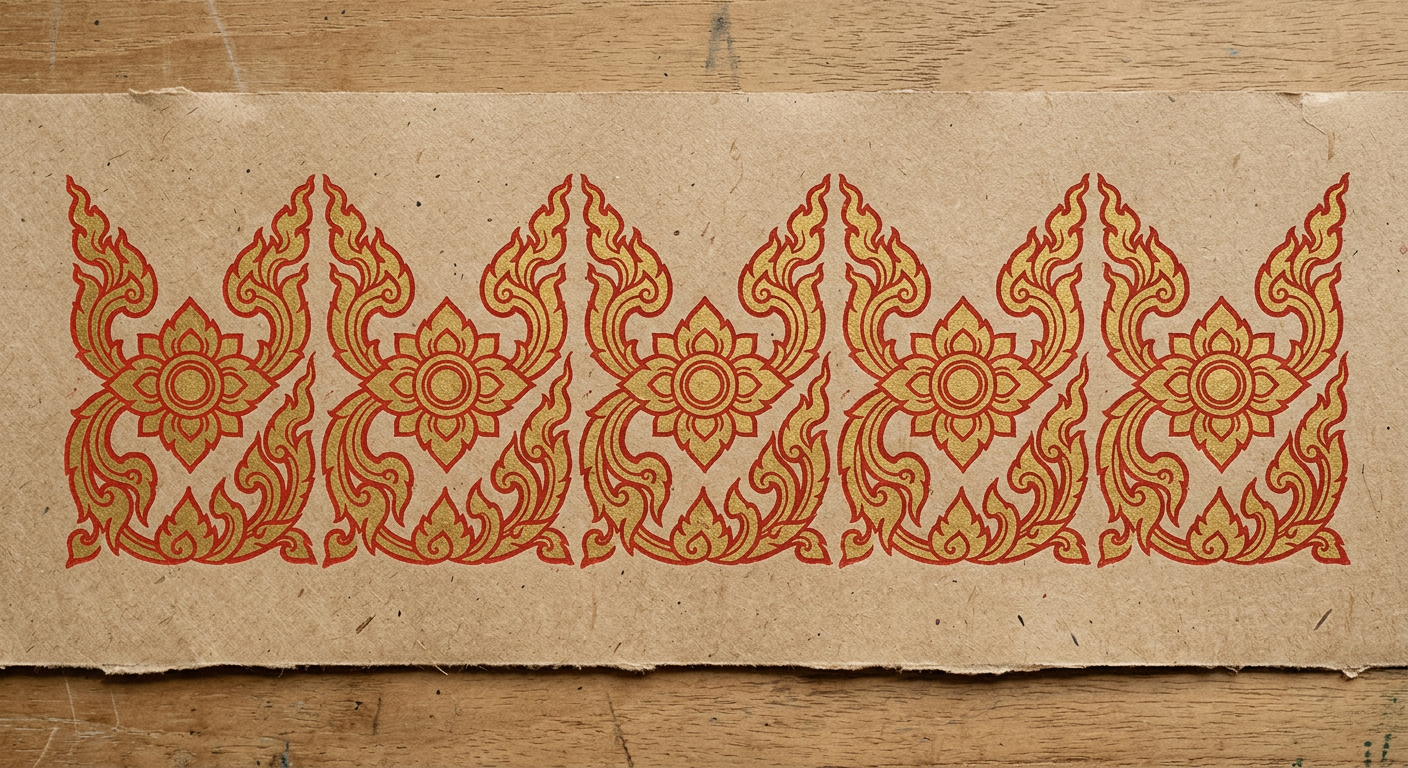

What the Thai border is
Thai border patterns, known collectively as Lai Krob (ลายกรอบ, “frame pattern”) or as specific named repeats, are the continuous motif bands used to frame temple mural panels, manuscript pages, textile fields, and lacquer compositions — approximately thirty canonical repeat types, each built from one or two modular elements arrayed along a horizontal or vertical axis. Border work is the workhorse of Thai ornamental tradition. Every composition, from the smallest manuscript page to the largest temple wall, uses borders to define register, separate zones, and carry the ornamental vocabulary in its simplest repeatable form.
For graphic designers, borders are the single most useful element from Thai pattern tradition because they adapt naturally to modern layout — keylines, packaging trim, book page edges, web dividers, tableware rims — without requiring the full cultural and compositional apparatus of a temple pediment or a royal rosette.
This page documents the major border families and provides a vector pack of thirty common repeats. Individual-motif pages (Lai Kanok, Mek Lai, Pra Jum Yam, Lai Dok Mai) cover the source motifs that feed into these border compositions.
Origin and historical context
Thai border patterns as a codified system developed across the Ayutthaya and early Rattanakosin periods (14th–19th century), drawing on individual motifs that themselves predate the border system and absorbing repeat-structure conventions from Chinese, Khmer, and Persian ornamental traditions encountered through trade and diplomacy. The Ayutthaya-period consolidation is the key moment — the royal craft guilds of Ayutthaya formalised the thirty-or-so canonical repeats that remain the standard reference.
The Fine Arts Department’s Dictionary of Thai Ornament catalogues the borders by structural type (chain, undulation, reciprocal, reciprocal-with-fill, linked-medallion) and by source motif (Kanok-based, Mek Lai-based, floral-based, figurative-based). The Silpakorn course handbook covers the thirty most-reproduced borders in its second-year Thai ornamental drawing module.
Rattanakosin-period temple restoration and new construction under Rama I through Rama V institutionalised the borders as the standard ornamental language for royal and religious work, and the post-World-War-II Fine Arts Department conservation programmes have kept the borders in continuous living use on temple restoration and new royal construction.
Construction and geometry
Thai border construction follows four core structural types, each with fixed proportional rules, and every individual border is named and classified within one of these types. The four structural types:
| Type | Thai term | Description | Common proportion |
|---|---|---|---|
| Chain | Khrua (เครือ) | Modular motifs linked tail-to-head along the axis | 1:3 height to unit-width |
| Undulation | Khlune (คลื่น) | Continuous wave with motifs in crests and troughs | 1:2 height to wave-period |
| Reciprocal | Sa-lap (สลับ) | Two motifs alternating, typically upright and inverted | 1:2 height to reciprocal-pair-width |
| Medallion-linked | Prajam Yam Khrua (ประจำยามเครือ) | Circular medallions connected by scrolling tendrils | 1:4 height to medallion-unit |
Construction rules shared across the types:
- Baseline and ceiling. Set a horizontal baseline and ceiling defining the border height. Vertical borders use analogous left-right limits.
- Unit division. Mark the repeat unit along the axis. Proportion is set per type.
- Motif placement. Place the source motif(s) in fixed positions within each unit. Kanok-based chain borders have one Kanok per unit. Reciprocal borders have two motifs per unit. Medallion-linked borders have one central medallion plus two connecting tendrils per unit.
- Connective scrolls. Use Lai Kan Kot (scrolling tendril) or Lai Kan Yaeng (branching vine) to link units into a continuous flow. The scrolls must maintain directional consistency along the full border length.
- Register stacking. Primary border, secondary contrast border, and plain divider line. The Office of Traditional Arts handbook documents this as the canonical three-register border system on temple murals.
Thirty named borders cover the common range of Thai ornamental framing needs. The most frequently reproduced include Kanok Khrua (chained flame), Kanok Sa-lap (reciprocal flame), Prajam Yam Khrua (medallion-linked rosette), Mek Khrua (chained cloud), Dok Pikun Khrua (small-flower chain), and Lai Kan Kot Sa-lap (reciprocal scrolling tendril).
Where it traditionally appears
Thai borders appear on every major class of Thai ornamental object — temple murals, manuscript cabinets, mother-of-pearl inlay, ceremonial textiles, lacquer trays, royal stationery, and ceremonial invitations — functioning as the connective tissue between figurative and structural elements. Named references:
- Wat Phra Kaew mural borders — the Ramakien cycle murals use a three-register border system throughout, with the primary border alternating Kanok Khrua and Prajam Yam Khrua across the cycle
- Wat Suthat ordination hall — Mek Khrua borders dominate the ceiling panels, framing figurative registers
- National Museum Bangkok manuscript cabinets — 17th–19th century cabinets preserve the full range of lacquer borders
- Royal court textile sashes (sabai) — woven borders on court dress, documented at Queen Sirikit Museum of Textiles
- Mother-of-pearl inlay on monastic fan covers (phat yot) — borders in tiny nacre tesserae showing the borders at small scale
- Rama V-era royal stationery — printed borders on royal correspondence, preserved in the National Archives
- Contemporary temple restoration — the Fine Arts Department conservation programme continues to reproduce the canonical borders on temples undergoing restoration
Regional variants matter. Lanna (northern) borders compress the motifs and add Burmese influence. Southern borders preserve older Srivijaya-period floral vocabulary. Isan (northeastern) borders carry Lao and Khmer crossover.
Cultural meaning and restrictions
Thai borders as a category carry no formal legal or ceremonial restrictions, and every one of the thirty canonical repeats is fully available for commercial, editorial, and decorative design use — with the caveat that specific source motifs within a border carry their own individual restrictions. The borders built from Lai Kanok, Mek Lai, Lai Dok Mai, and Pra Jum Yam (eight-petal) are unrestricted. Borders that incorporate Garuda, sixteen-petal Pra Jum Yam, Yantra, or Buddha figures inherit the restrictions of those source motifs.
Practical rules:
- No weekday associations.
- No Royal Household Bureau approval required for the standard thirty borders.
- Kanok-based borders are fully available.
- Mek Lai-based borders are fully available.
- Floral borders are fully available (with the champa/funerary exception noted on the Lai Dok Mai page).
- Figurative borders — those incorporating Kinnari, Naga, or celestial figures — are available but carry the cultural-register expectations of those figures.
- Directional consistency is a strong convention. Reversing the flow of motifs mid-border reads as a visible error.
Modern usage in graphic design
Borders are the most frequently reused element of Thai pattern tradition in contemporary design, because their repeat-unit structure translates directly to modern layout needs — keylines on packaging, book page rules, tableware rims, web dividers, ceremonial stationery, and brand-system edge treatments. Representative recent examples:
- Mandarin Oriental Bangkok menu and stationery suite — simplified Kanok Khrua border in copper foil on cream stock, used as the page-edge rule across the brand system
- King Power duty-free heritage collection (2021) — Prajam Yam Khrua medallion-linked border on premium packaging, printed in gold foil
- Thai Airways Royal Silk Class menu covers — Mek Khrua border as a top-and-bottom rule on the menu layout
- Siam Paragon Chinese New Year campaign 2024 — Kanok Sa-lap reciprocal border adapted into mall wayfinding and shopping bag print
- Chiang Mai Design Week programme (2023) — Lai Kan Kot Sa-lap scrolling tendril border used as a section divider in the programme book
- Wedding invitation suites by Thai stationery studios — Dok Rak Khrua (ixora chain) and Dok Mali Khrua (jasmine chain) borders are industry standards for Thai-themed invitations
The borders adapt well to small scale (6–12 pt keylines), medium scale (packaging trim), and large scale (architectural and signage). Reduction to two-colour or single-colour renderings works cleanly. The one failure mode is over-use — stacking three or four borders of the same type on a single artefact reads as cluttered.
Free download
The Thai border pack on /patterns/downloads/ provides all thirty canonical repeats as CC BY 4.0 seamless-tileable SVG and AI files, organised by structural type (chain, undulation, reciprocal, medallion-linked) and by source motif (Kanok, Mek Lai, floral, figurative). Each border ships with a construction-grid overlay layer and a single-tile-unit version for custom pattern assembly. Use the Thai Pattern Maker to recolour and scale, and combine with the individual motif pages — Lai Kanok, Mek Lai, Lai Dok Mai — to understand the source vocabulary feeding each border.
Pattern generator: Thai Border Patterns
Set the tile size, stroke, color and rotation, then download the seamless Thai Border Patterns tile as SVG or PNG.
Showing Thai border — tile 120px, stroke 2, rotation 0°.
Tiles are drawn in code from the motif's geometry — reconstructions, not tracings of one artefact. Exports are CC BY 4.0; credit ThaiGraph.com. For the full-size canvas, open the Thai Pattern Generator.
Information verified as of April 2026
Sources
- Thai ornamental borders (Lai Krob) are classified into approximately thirty named repeat types, with each repeat built from one or two modular motifs arrayed along a horizontal or vertical axis.—Fine Arts Department, Ministry of Culture, Thailand — Dictionary of Thai Ornament, 1999 edition (accessed Apr 10, 2026)
- Standard Thai border proportions use a 1:3 height-to-repeat-width ratio for primary borders and a 1:2 ratio for secondary border registers.—Faculty of Decorative Arts, Silpakorn University — Thai Ornamental Drawing course handbook, 2020 edition (accessed Apr 10, 2026)
- The Kranok Khrua border (chained flame motif) is the most widely reproduced Thai border type and is documented on temple pediments, manuscript cabinets, and textiles from the Ayutthaya period onward.—Chamni Reuangritt (2009). ตำราลายไทย (Thai Ornament Manual). Amarin Printing, Bangkok (accessed Apr 10, 2026)
- Thai border hierarchy in temple murals follows a fixed register sequence — thick principal border, thin contrasting border, scrolling tendril border, and plain divider line — repeated for each composition zone.—Office of Traditional Arts, Ministry of Culture — Thai Mural Conservation Handbook, 2016 (accessed Apr 10, 2026)