Thai pattern · yantra
Yantra (Sak Yant)
สักยันต์

Information verified as of April 2026

What the Yantra is
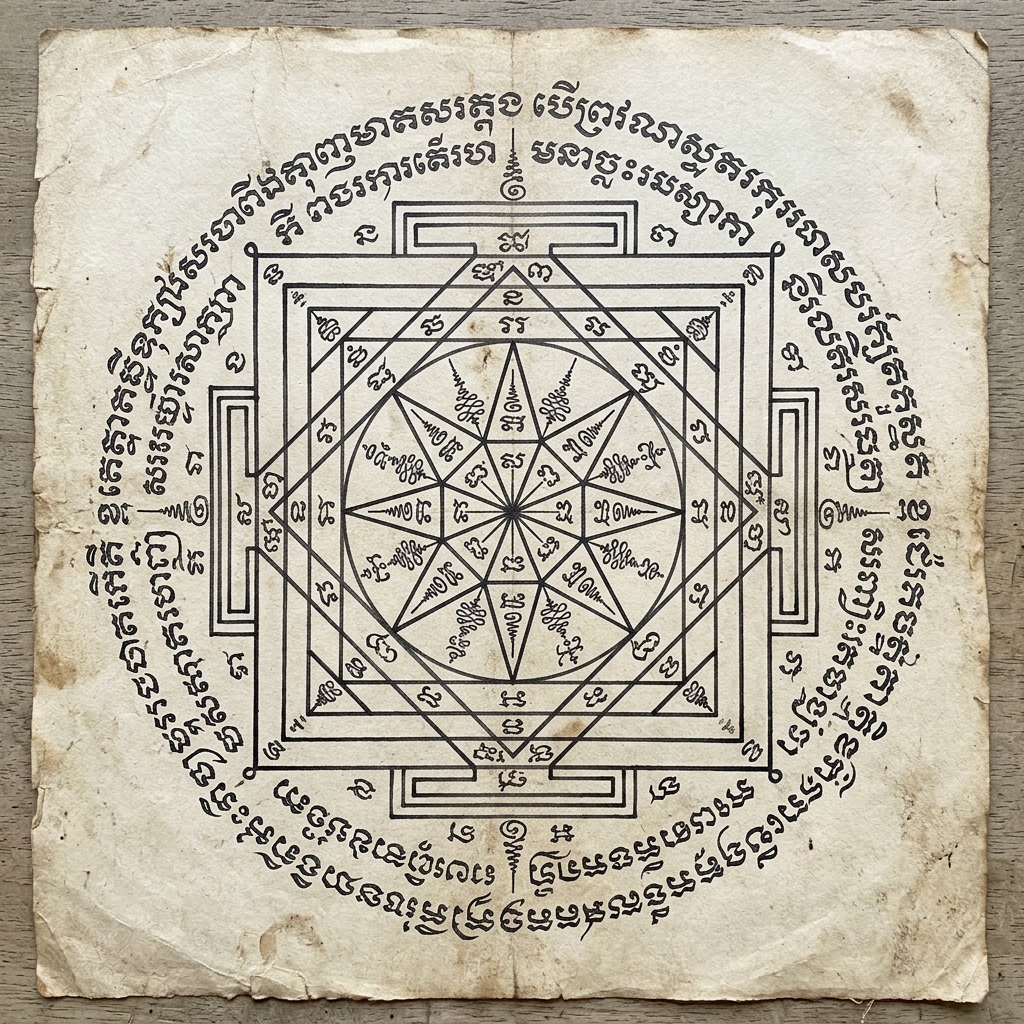
Yantra, known in Thai as Sak Yant (สักยันต์), is the sacred geometric tradition of Thai Theravada Buddhism — roughly eighty-five canonical designs combining Pali-Khmer script with grid-based symbolic geometry, traditionally applied as tattoos, cloth amulets (pha yant), or protective banners under the supervision of an ajarn (master) practitioner. Each design carries specific protective or empowering meaning, is activated by recited Pali-Khmer incantations (kata) during inscription, and is understood within the tradition as a living religious object rather than decorative ornament.
This is the only motif in the ThaiGraph pattern library that is not recommended for commercial graphic design use. Unlike Lai Kanok or Mek Lai, Yantra is not a cultural vocabulary that has been secularised. It is religious material, actively in use, taught by lineage-holding practitioners, and treated by Thai Buddhist authorities and the general Thai public as sacred. Commercial appropriation — Yantra on a T-shirt brand, a beverage label, a trendy logo — is broadly considered disrespectful by both the Sangha and the lay Thai population.
This page exists to document the tradition for designers who need to understand it (to recognise it, to avoid misusing it, or to work within its conventions on legitimate cultural and editorial briefs), not to license its use.
Origin and historical context
Sak Yant derives from the Theravada forest-tradition monastic lineage of Thailand, with close historical ties to Lanna (northern), central, and southern Thai monasteries, and draws on pre-Buddhist Indian yantra geometry combined with Pali-Khmer script. The tradition is older than documentation allows us to trace precisely — continuous practice is documented from the Lanna period (late 13th century forward) and likely predates that.
The Khmer component is critical. Sak Yant inscriptions almost always include Khmer script or Khmer-Pali hybrid script rather than Thai script, because the Khom (Khmer-derived) script was the sacred liturgical script of the Thai Theravada tradition for most of its history. This gives Sak Yant its distinctive typographic character: a Thai tradition visually encoded in Khmer letterforms.
Individual Sak Yant designs are associated with specific lineages and specific ajarn. The most widely known contemporary lineage is that of Luang Pho Pern of Wat Bang Phra (Nakhon Chai Si, central Thailand), whose Wai Khru (teacher-veneration) festival in March draws tens of thousands of tattooed devotees annually. Ajarn Noo Kanpai, Ajarn Hnu Ganpai’s student base, and former-monk ajarn in Lanna lineages represent other active traditions.
Construction and geometry
Sak Yant designs are constructed on grid-based geometry with Pali-Khmer script integrated as both content and composition element — the text is not a caption to the design, it is a structural component of it. The principal design categories:
| Design | Thai name | Primary meaning | Composition |
|---|---|---|---|
| Five Lines | Hah Taew (ห้าแถว) | Protection, luck, charm, fortune | Five horizontal lines of Khmer script |
| Nine Spires | Gao Yord (เก้ายอด) | Nine Buddhas, universal protection | Nine conical spires arrayed in a pyramid |
| Octagonal | Paed Tidt (แปดทิศ) | Protection in eight directions | Octagonal grid with compass script |
| Unalome | Unalome (อุณาโลม) | Path to enlightenment | Spiral tapering to a straight line |
| Tiger | Suea Paen (เสือเผ่น) | Authority, command | Tiger figure with script inscriptions |
| Garuda (protective) | Khrut (ครุฑ) | Power, royal protection | Garuda figure in Yantra geometry |
| Hanuman | Hanuman (หนุมาน) | Strength, valour | Hanuman figure in geometric border |
| Geometric square | Yant See Liam (ยันต์สี่เหลี่ยม) | Foundation protection | Square grid with four-corner Pali |
Construction shares common rules:
- Grid foundation. The design is built on an underlying geometric grid (square, octagonal, or radial) that determines script placement and figure proportions.
- Pali-Khmer script integration. Script is placed along grid lines, inside figures, and around borders as both content and visual element. Script is always in Khom (Khmer-derived) characters, not Thai.
- Figure geometry. Animal or deity figures follow Thai classical drawing conventions adapted to the confines of the grid.
- Border enclosure. Almost every Sak Yant has a border frame, either a rectangular grid or a circular enclosure, isolating the sacred space from its surroundings.
- Axis symmetry. Most designs are symmetrical along one or two axes.
Where it traditionally appears
Sak Yant appears primarily as tattoos on the backs, shoulders, and chests of devotees who have received ajarn-supervised inscription, secondarily on cloth amulets (pha yant) carried or displayed, and on protective banners hung in homes, shops, and temples. Primary contexts:
- Wat Bang Phra, Nakhon Chai Si — the best-known centre of Sak Yant practice, site of the annual Wai Khru festival attended by tens of thousands
- Wat Suthat Wai Khru practice, Bangkok — urban equivalent festival
- Forest-tradition monasteries across Thailand — many forest monasteries maintain ajarn practice
- Pha Yant cloth amulets — printed cotton or silk cloths with Yantra designs, used as household protection or carried in wallets, widely available at temples and amulet markets
- Thai boxing (Muay Thai) — pre-match blessings at major stadiums often include Sak Yant reference and fighters frequently display Yantra tattoos
- Military and police traditions — certain Thai military and police lineages maintain Yantra practice for protection
- Southeast Asian diaspora — Thai and Lao communities in Cambodia, Malaysia, Singapore, and Western countries
The Angelina Jolie tattoo of 2003, inscribed by Ajarn Noo Kanpai, brought Sak Yant to international attention and triggered a wave of Western tourist demand that the Thai Sangha has since publicly discouraged.
Cultural meaning and restrictions
Sak Yant is sacred religious material, currently in active use, and commercial or decorative appropriation is considered disrespectful by the Thai Sangha and general public — no legal prohibition exists, but social and professional consequences in Thailand are real. This is the single strongest cultural restriction of any motif in the ThaiGraph library.
Specific considerations:
- No Royal Household Bureau approval is required — Yantra is not a royal symbol. But the cultural weight is arguably greater than Garuda’s legal weight.
- The Thai Sangha has publicly discouraged commercial use. National Office of Buddhism statements in 2019 and 2022 addressed tourist commodification specifically.
- Traditional practitioner rules apply to inscription, not to representation. Reproducing a Yantra in a book or educational article is not itself an offence; using one as a brand logo is a social offence.
- The depicted Buddha on certain Yantra adds legal weight. Thai law treats Buddha images with respect requirements, and Yantra featuring Buddha figures fall under these.
- Foreigner sensitivities are heightened. Non-Thai brands using Yantra are scrutinised more sharply than Thai brands, which are assumed to understand the tradition.
The ethical design practice is to treat Yantra as analogous to religious iconography generally — available for editorial, academic, and cultural commentary, not available for appropriation as decoration.
Modern usage in graphic design
Legitimate contemporary use of Yantra in Thai design is overwhelmingly editorial, academic, museum, or documentary — not commercial or decorative — and even those uses are preceded by consultation with practitioners and cultural authorities. Recent work fitting this pattern:
- Museum of Contemporary Art (MOCA) Bangkok exhibitions featuring Sak Yant as subject matter
- Thai Film Archive publications on Thai supernatural cinema, which engage with Sak Yant iconography
- Academic books including the Drouyer and Cummings references in the sources section above
- Documentary photography by Thai photographers including Cedric Arnold’s long-term Sak Yant series
- Editorial illustration in Thai cultural journals and foreign design publications covering the tradition respectfully
- Museum signage and interpretive material at Wat Bang Phra and other centres
Applications to avoid: fashion apparel, fast-moving consumer goods, hospitality branding, tattoo studio logos outside the ajarn tradition, generic “exotic Thai aesthetic” product lines. Thai designers will generally refuse these briefs; foreign designers who accept them typically face negative reception when the work reaches Thai audiences.
Free download
A reference Yantra geometric diagram is available on /patterns/downloads/ under a restrictive educational-use-only license, provided strictly for academic, editorial, and museum use. The file is an unblessed geometric construction without Pali-Khmer script — the script is intentionally omitted because the traditional view holds that script placement without ajarn consecration is inappropriate. For further reading see the Drouyer and Cummings sources cited above, and for unrestricted Thai ornamental alternatives see the Lai Kanok page and the patterns index.
Pattern generator
The generator has no Yantra tile yet, so it opens on the nearest motif it can draw, Pra Jum Yam. Set the tile size, stroke, color and rotation, then download the result as SVG or PNG.
Showing Pra Jum Yam — tile 120px, stroke 2, rotation 0°.
Tiles are drawn in code from the motif's geometry — reconstructions, not tracings of one artefact. Exports are CC BY 4.0; credit ThaiGraph.com. For the full-size canvas, open the Thai Pattern Generator.
Information verified as of April 2026
Sources
- Yantra (Sak Yant) traditional tattoo designs are codified into approximately eighty-five canonical configurations documented in the Pali-Khmer manuscripts preserved across Thai forest-tradition monasteries.—Cummings, J. (2011). Sacred Tattoos of Thailand. Marshall Cavendish (accessed Apr 10, 2026)
- Sak Yant inscription requires consecration by an ajarn (master) practitioner, typically a monk or former monk in the forest tradition, and is accompanied by recited Pali-Khmer incantations (kata) during application.—Drouyer, I. R. and Drouyer, R. (2013). Thai Magic Tattoos: The Art and Influence of Sak Yant. River Books, Bangkok (accessed Apr 10, 2026)
- The Hah Taew (Five Lines) is the most widely recognised Yantra, traditionally blessed with five distinct kata corresponding to the five lines, and attributed to the Lanna tradition under Luang Pho Pern's lineage.—Drouyer, I. R. and Drouyer, R. (2013). Thai Magic Tattoos: The Art and Influence of Sak Yant. River Books, Bangkok (accessed Apr 10, 2026)
- The Thai Sangha Supreme Council has issued public statements discouraging commercial and tourist commodification of Yantra iconography, though no legal prohibition exists.—National Office of Buddhism, Thailand — public statements on Sak Yant practice, 2019 and 2022 (accessed Apr 10, 2026)