Thaitone · green
Celadon
เขียวเซลาดอน
(khiao seladon)

Information verified as of April 2026
- HEX
-
#93A287 - RGB
-
147, 162, 135 - CMYK
-
9, 0, 17, 36 - HSL
-
93°, 13%, 58% - Tailwind
-
bg-[#93a287] - Thaitone index
- #10
What Celadon is
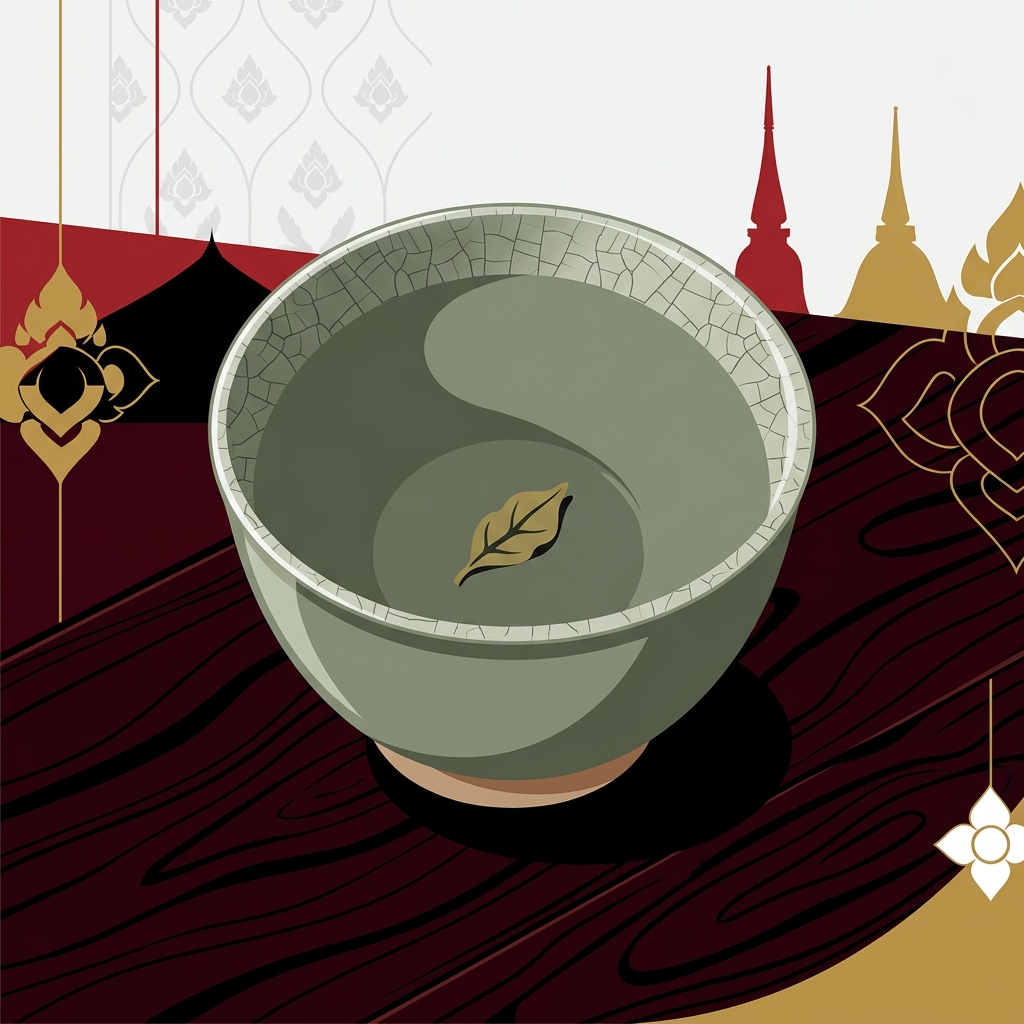
Thai Celadon (เขียวเซลาดอน, khiao seladon) is the soft sage green of Sangkhalok ceramic glaze — a low-saturation, slightly grey-green at #93a287 that sits between warm and cool and carries the signature muted quality of reduction-fired iron glaze. The color is specifically tied to the ceramic tradition of Si Satchanalai and Sukhothai kilns active from roughly the 13th to 16th centuries.
Pittayamatee’s Thaitone entry places the canonical hue in the neutral craft category. It is darker and warmer than Chinese Longquan celadon but lighter and cooler than Korean Goryeo celadon, which is the lineage Thai ceramicists position themselves within.
Where this color traditionally appears
The canonical reference is Sangkhalok stoneware — the fish plates, covered boxes, and jars produced at Si Satchanalai that were the dominant regional ceramic export through mainland Southeast Asia in the Sukhothai period. Museums across Thailand and Southeast Asia hold major Sangkhalok collections.
The color appears on modern Chiang Mai celadon revival ware produced at Siam Celadon, Mengrai Kilns, and the Doi Tung ceramic studios. It is also standard on reproduction temple tile for restoration projects and on contemporary Thai tableware aimed at heritage hospitality.
What it means in Thai culture
Thai Celadon signals craft heritage, Sukhothai and Lanna identity, and quiet sophistication. It does not carry royal or religious restriction and is considered a safe, high-register color for design.
The color reads as northern Thai by default. Chiang Mai hotels, restaurants, and craft studios use celadon both as tableware and as brand color, which has strengthened the association. It is one of the small number of Thai craft colors with international recognition — celadon buyers in Japan, Europe, and the US understand the category.
Using Celadon in modern design
Thai Celadon works best for heritage hospitality, wellness and spa, and premium craft retail. Three concrete briefs:
- Chiang Mai boutique hotel identity — 60–80% celadon field with teak and rice paper accents; reads as Lanna craft hospitality at international luxury register.
- Wellness, spa, and natural beauty brands — celadon label system with cream and black typography; the muted green codes as calm and natural.
- Heritage ceramics and homeware retail — celadon alongside teak and lacquer black; a direct recreation of the Sangkhalok display register.
It fails for food packaging where the muted green reads as faded, and for tech brands where the colour is too craft-referential.
Complementary colors
Three pairings carry Celadon cleanly. With Rice Paper, the combination is the canonical Lanna craft register — celadon tableware on cream cloth, translated directly into editorial. With Lacquer Black, the contrast sharpens the celadon into editorial sophistication, suitable for menus and cultural catalogues. With Teak, the pairing reconstructs the northern Thai interior palette — celadon ceramic on teak wood — used across contemporary Chiang Mai hospitality.
Browse the full Thaitone system or open the color picker to build a palette.
Information verified as of April 2026
Sources
- Documented in the Thaitone system as one of 168 traditional Thai colors.—Pittayamatee, P. (1988). Thai Colour. Amarin Printing, Bangkok. (accessed Apr 10, 2026)
- Sangkhalok celadon ware from Si Satchanalai and Sukhothai kilns (13th-16th centuries) achieved its characteristic sage-green glaze through iron-rich wood-ash formulations fired in reduction.—Brown, R. M. (1988). The Ceramics of South-East Asia. Oxford University Press, Kuala Lumpur. (accessed Apr 10, 2026)