Thaitone · green
Banana Leaf
เขียวใบตอง
(khiao bai tong)

Information verified as of April 2026
- HEX
-
#4A7A3E - RGB
-
74, 122, 62 - CMYK
-
39, 0, 49, 52 - HSL
-
108°, 33%, 36% - Tailwind
-
bg-[#4a7a3e] - Thaitone index
- #9
What Banana Leaf is
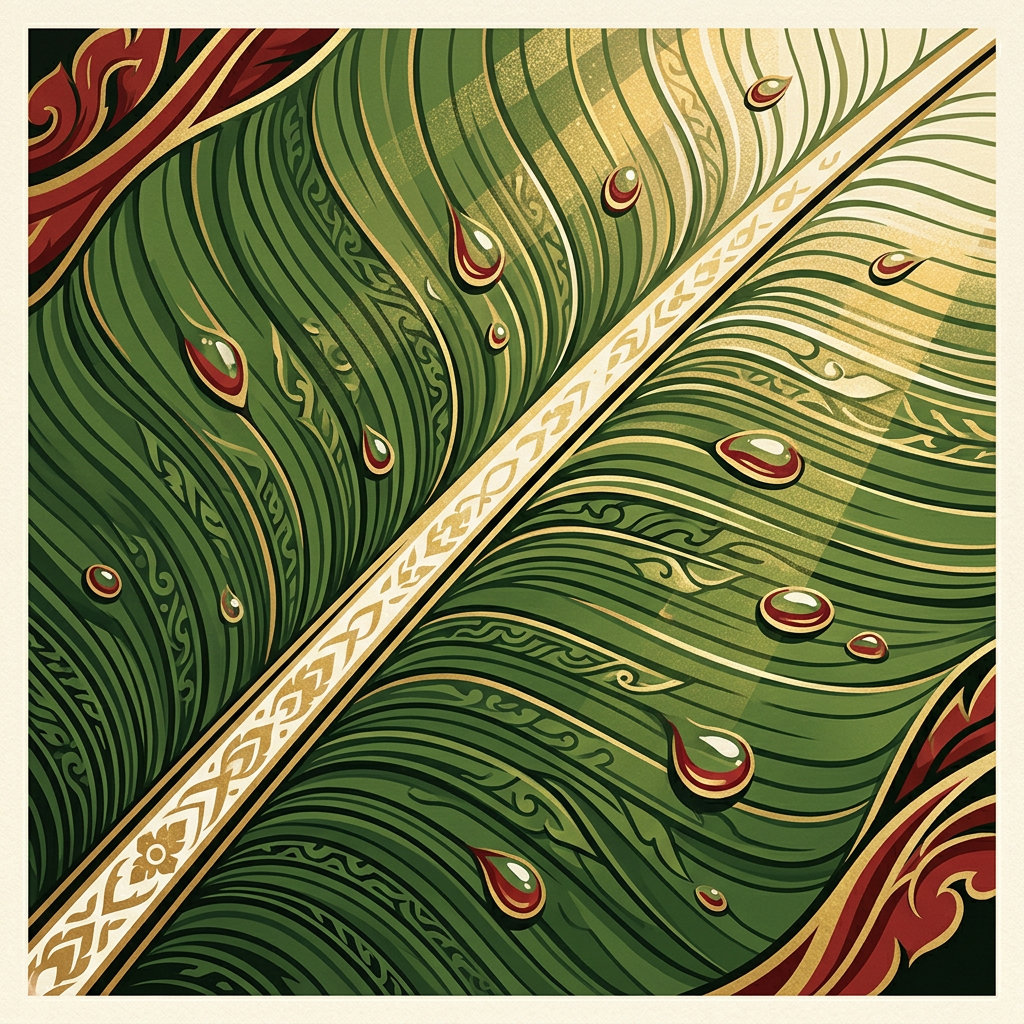
Banana Leaf Green (เขียวใบตอง, khiao bai tong) is the saturated tropical green of fresh banana leaves used in Thai food and craft — a mid-saturation yellow-biased green at #4a7a3e that reads as alive and tropical rather than forest-dark. The reference is the upper surface of a mature Musa paradisiaca leaf in direct tropical sun.
Pittayamatee’s Thaitone entry places it inside the everyday (wisai) category. It is lighter than pandan green and darker than young rice-plant green. The color reads as edible, fresh, and tied to food preparation rather than religious or royal contexts.
Where this color traditionally appears
The canonical reference is the wrapping leaf used for khao tom mat, khanom sai sai, and grilled-fish packages at Thai markets across every region. Banana leaf functions in Thai daily life as plate, wrapper, and steamer lining, with the green visible constantly at markets, temples, and food stalls.
The color appears on temple offering trays (khan toke arrangements), Loy Krathong float bases, the woven leaf bai si offering cones used at wedding and blessing ceremonies, and as the dominant green in pad thai, som tum, and grilled dishes served on leaf. It is not typically a silk or dye color — banana leaf green exists in Thai culture as the color of the leaf itself rather than a pigment.
What it means in Thai culture
Banana Leaf signals food, hospitality, and everyday Thai life — a warm, welcoming green with no royal or religious restriction. The Royal Institute Dictionary documents khiao bai tong as a common color term describing freshness and tropical vitality.
The color carries strong association with Thai food culture specifically and does not code strongly to weekday color systems. Its use in branding is considered safe across categories, though it reads most specifically as Thai food when used at full saturation.
Using Banana Leaf in modern design
Banana Leaf works best for Thai food brands, craft market identity, and hospitality aiming at casual authenticity. Three concrete briefs:
- Thai food product packaging — 60–80% banana leaf field with cream and red accents; reads as fresh Thai food at both local and export retail.
- Craft market and street food festival identity — full-field green with hand-rendered type; signals craft authenticity and Thai origin.
- Casual restaurant and delivery brand — banana leaf as dominant brand color paired with rice paper; works for casual dining chains aiming at approachable Thai positioning.
It fails for luxury hospitality (too casual), tech (too literal), and wellness (too green-bright).
Complementary colors
Three pairings carry Banana Leaf cleanly. With Rice Paper, the combination is the canonical Thai food palette — green on cream is how Thai dishes photograph best and translates directly into editorial and packaging. With Thai Vermilion, the pairing evokes festival and temple offering trays at a higher saturation register. With Jasmine, the green reads as craft-market signage and casual restaurant identity with a slightly warmer base than rice paper.
Browse the full Thaitone system or open the color picker to build a palette.
Information verified as of April 2026
Sources
- Documented in the Thaitone system as one of 168 traditional Thai colors.—Pittayamatee, P. (1988). Thai Colour. Amarin Printing, Bangkok. (accessed Apr 10, 2026)
- Banana leaf (Musa paradisiaca) is the primary wrapping material in Thai traditional food preparation and temple offering, with documented use across every Thai region.—Sitthithanyakij, T. (2010). Thai Food Culture. Chulalongkorn University Press, Bangkok. (accessed Apr 10, 2026)